ع
ع


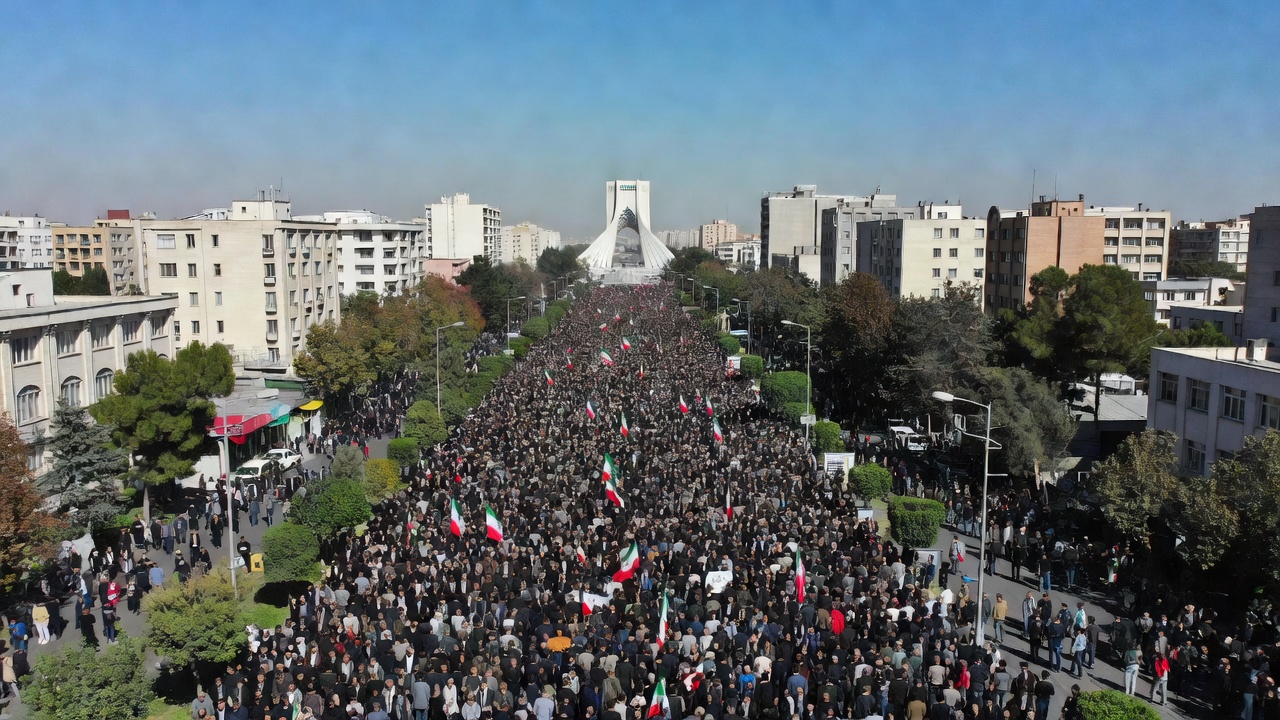
Crowds estimated by Tehran officials in the millions marched through the Iranian capital on Monday for the main day of processions marking the funeral of Ayatollah Ali Khamenei, who was killed alongside his wife in an Israeli airstrike on February 28 that opened a four-month war with the United States and Israel, according to Reuters. The flag-draped coffin was carried slowly along a 10-kilometer route from Imam Hossein Square in eastern Tehran to Azadi Square in the west, passing through Enghelab Square as state television broadcast images of mourners waving Iranian flags and red banners symbolizing calls for revenge. President Masoud Pezeshkian walked among the participants while former president Mahmoud Ahmadinejad was also seen in the crowds, a detail noted in reporting by The New York Times.
The body had lain in state for two days at Tehran’s Grand Mosalla mosque, where three of Khamenei’s sons prayed beside the coffin on Sunday, CNN reported from the scene. Mojtaba Khamenei, long viewed as a potential successor to his father as supreme leader, remained absent from all public ceremonies after being wounded in the same strike, Reuters correspondents confirmed in their coverage of the day’s events. Iranian authorities have released no official updates on the succession process even as the multi-day commemorations continue.
Mourners carried placards demanding death to U.S. President Donald Trump and Israeli Prime Minister Benjamin Netanyahu while some threw stones at a billboard featuring Trump’s image, footage reviewed by Al Jazeera showed. Chants of “We must rise” and “The U.S. killed our father” echoed along the route, reflecting widespread anger over the strike that also prompted preliminary negotiations mediated by Qatar to end the conflict and reopen the Strait of Hormuz, according to statements carried by Reuters. Israeli Defense Minister Israel Katz said in a released statement that Khamenei had been eliminated because he threatened Israel’s existence and that any future Iranian leader pursuing the same path would face the same fate.
Pezeshkian posted on X that Khamenei had taught that the greatest asset is the people and their unity, urging the nation to continue on the path of honor, progress and glory, the post showed. The procession formed the centerpiece of what authorities described as a week of ceremonies expected to draw up to 20 million participants in Tehran alone, a figure cited by the city’s mayor and reported by i24NEWS. Organizers imposed strict crowd-control measures, including temporary closure of Tehran airspace, to avoid repeats of the chaos that marked the 1989 funeral of Ayatollah Ruhollah Khomeini, The Straits Times noted in its coverage.
After the Tehran events the coffin is scheduled to travel to the holy city of Qom on Tuesday for further ceremonies before proceeding to the Iraqi shrine cities of Karbala and Najaf on Wednesday and concluding with burial Thursday at the Imam Reza shrine in Mashhad, a route mapped by Al Jazeera based on official announcements. The extended program across Iran and Iraq underscores the religious significance of the sites for Shiite Muslims and aims to reinforce the clerical establishment’s hold on power following the leadership vacuum created by the strike, The Guardian reported from the scene. Iranian state media emphasized themes of resilience and defiance throughout the broadcasts.
The funeral unfolds against the backdrop of a preliminary agreement reached through Qatari mediation that includes steps toward a final deal on Iran’s nuclear program, sanctions relief and a broader truce, details outlined in updates from CNN. Authorities have not disclosed casualty figures from the initial strike or subsequent fighting, but the scale of public participation has been presented by officials as evidence of continued popular support for the Islamic Republic’s system despite the external threats that led to Khamenei’s death.