ع
ع


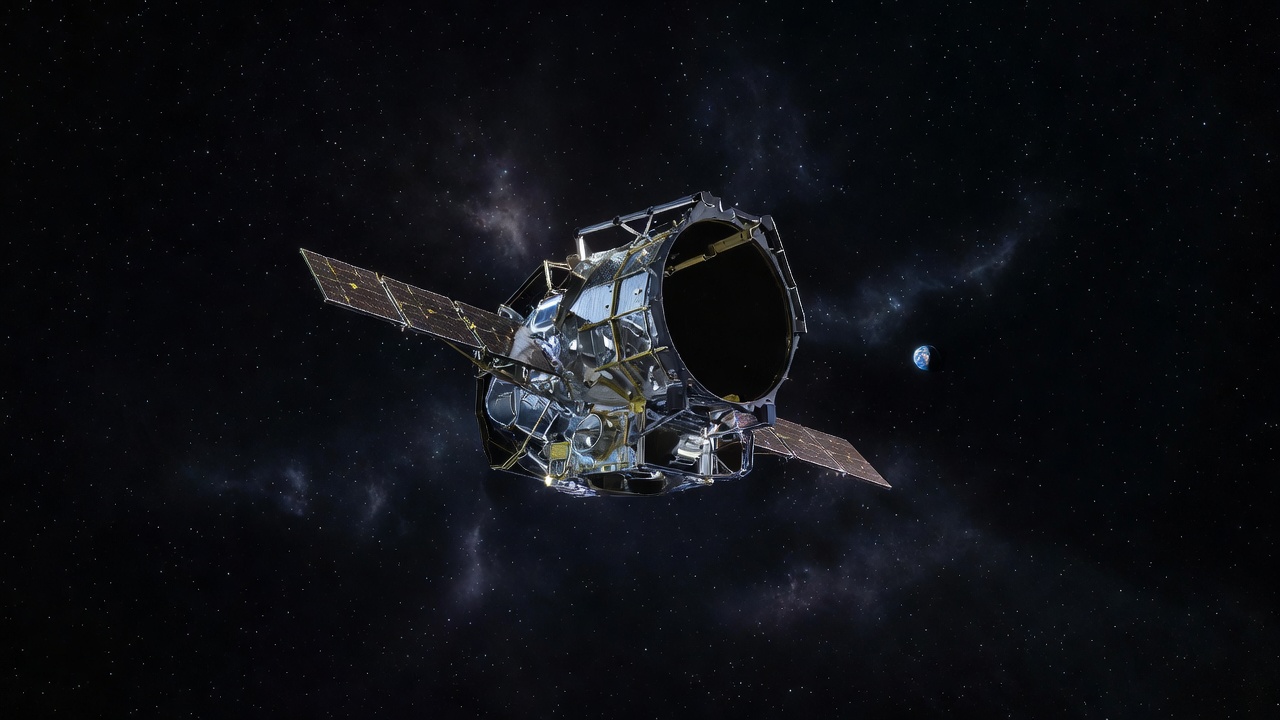
The Nancy Grace Roman Space Telescope lifted off at 7:26 a.m. ET from Kennedy Space Center’s Launch Complex 39A, separating cleanly from the Falcon Heavy booster en route to the Sun-Earth Lagrange Point 2 roughly one million miles from Earth. NASA Administrator Nicky Fox stated that Roman is going to change the way we look at the Universe and is going to discover tens of thousands, maybe even 100,000 new exoplanets. A NASA Science overview indicated the observatory’s 2.4-meter primary mirror matches Hubble’s in size yet its Wide Field Instrument captures patches of sky at least 100 times larger while preserving comparable resolution. Over its five-year prime mission Roman will image more than 50 times as much sky as Hubble covered during three decades of operations, according to agency figures. The spacecraft also carries a coronagraph instrument designed to demonstrate advanced starlight suppression for direct imaging of exoplanets.
NASA data places Roman’s wide-field surveys as capable of mapping more than two billion galaxies and gathering up to 20 petabytes of information, creating the largest panoramic datasets ever returned from space. Forbes reported that while Hubble excels at detailed views of individual targets and the James Webb Space Telescope peers deeper into cosmic history, Roman will survey enormous swaths to reveal how those objects fit into the broader universe. A Planetary Society assessment found the telescope could detect 80,000 Type Ia supernovae useful for charting cosmic expansion in addition to surveying over one billion galaxies and nearly 100,000 cosmic voids. The mission’s infrared capabilities extend from 0.5 to 2.3 microns, allowing it to observe through dust and at greater distances than many ground-based instruments.
Scientists anticipate Roman will identify between 60,000 and 200,000 candidate exoplanets through transits and microlensing, a dramatic increase over the roughly 6,000 worlds confirmed to date, according to NASA projections. The observatory will monitor the crowded galactic bulge for brief brightenings caused by gravitational microlensing, revealing planets down to Earth-mass scales including potential free-floating worlds, a Planetary Society review noted. It may also capture the first direct image of an exoplanet with rings or confirm an exomoon while studying atmospheres of distant worlds to assess habitability. These findings will address whether solar systems like ours are common and what conditions foster life elsewhere.
The telescope bears the name of Nancy Grace Roman, NASA’s first chief astronomer who championed the Large Space Telescope that became Hubble, according to NASA historical accounts. Development began as the Wide-Field Infrared Survey Telescope concept recommended in the 2010 decadal survey before a donated 2.4-meter mirror from a national reconnaissance program expanded its ambitions, a Scientific American investigation detailed. Congress provided initial funding that grew from tens of millions annually until the project reached implementation in 2016 with a total lifecycle cost now estimated at $4.3 billion, NASA budget documents show. The European Space Agency contributes as a mission of opportunity, supplying elements that enhance the infrared survey capacity.
A NASA press kit distributed ahead of launch outlined how Roman will produce enormous cosmic panoramas that astronomers can use to explore dark energy, dark matter, black holes and objects ranging from the solar system to the observable universe’s edge. Jenifer Millard explained in remarks carried by the BBC that Roman will be four times further from Earth than the Moon to ensure infrared light from the Moon and Earth do not interfere with the cameras, allowing it to peel back layers of cosmic history like an onion. Jackie Townsend, the project manager, described a glorious dawn launch whose ride was magnificent and put the spacecraft right where it needed to be. Data will be released publicly without exclusive access periods so multiple teams can analyze it simultaneously.
Forbes noted that Roman’s ability to survey the sky roughly 100 to 1,500 times faster than Hubble at similar resolution will complement ongoing observations from both Hubble and Webb at the L2 point. The combined fleet will enable follow-up studies where Roman identifies interesting targets for higher-resolution scrutiny in ultraviolet or deeper infrared wavelengths. NASA figures show the mission could also detect hundreds of millions of stars within the Milky Way while tracking changes over repeated visits to the same fields. Such coordination is expected to accelerate discoveries across astrophysics in the years immediately following commissioning.