ع
ع


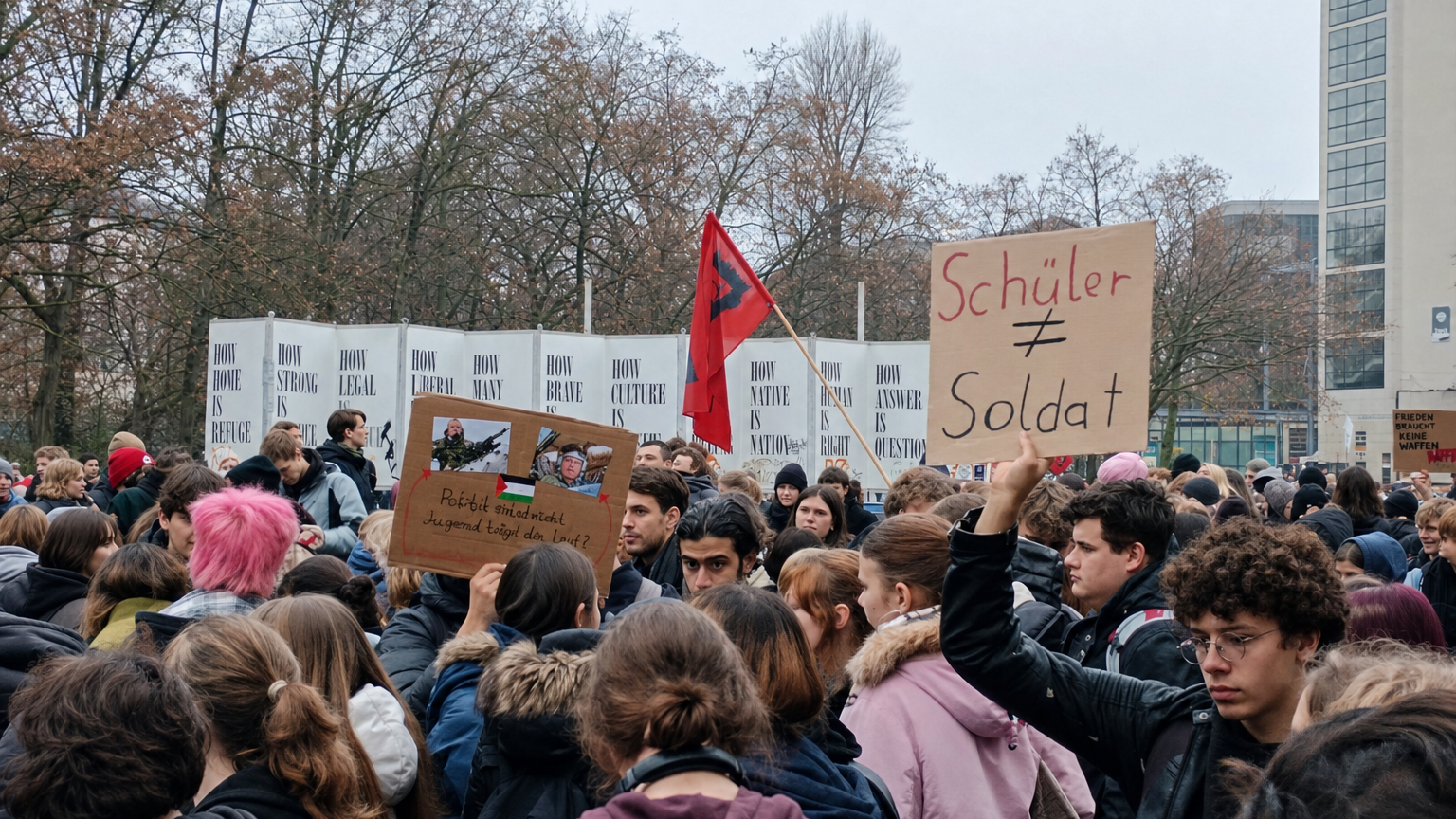
Organisers of the School Strike Against Compulsory Military Service reported that more than 45,000 pupils took part in protests and school boycotts on September 25, 2026, marking the fourth nationwide action day since the campaign began in late 2025. The demonstrations stretched from Kiel and Flensburg in the north to Munich and Stuttgart in the south, with police figures showing 2,400 participants in Berlin’s Wedding district, 700 in Munich and 400 in Nuremberg. Bela Breitner, a spokesperson for the initiative, said the federal government was serious about gradually reintroducing compulsory military service after some 18-year-olds who had expressed no interest in the armed forces received mandatory medical examination notices.
The protests unfolded against the backdrop of a military service modernisation law that took effect in January 2026 after parliament approved it the previous December, according to multiple German news outlets including tagesschau and Die Zeit. That legislation requires all men born after December 31, 2007, to complete fitness questionnaires and, from mid-2027, undergo physical checks, with the possibility of conscription if volunteer targets are not met. A Defence Ministry spokesperson told the BBC that the obligation to undergo medical examinations applies to all men liable for military service in that age group, while government data cited in separate reports indicated that fewer than 1,000 such examinations had occurred since the summer despite widespread notifications.
Earlier strikes organised by the same group drew comparable crowds, with roughly 50,000 participants in actions held in December 2025, March 2026 and May 2026, figures that a Rosa-Luxemburg-Stiftung analysis and Guardian coverage both placed in the context of growing youth opposition to remilitarisation. Protesters in Hamburg carried banners reading “We won’t take part in your wars,” while similar demonstrations in Freiburg and Stuttgart featured slogans such as “Never again conscription” and demands for investment in education rather than the armed forces. Police in several cities recorded lower turnout than organisers anticipated, with only 180 people in Frankfurt and 200 in Stuttgart, although the overall campaign has maintained momentum across more than 100 locations in each wave.
Chancellor Friedrich Merz has identified bolstering the Bundeswehr as a priority in response to Russia’s full-scale invasion of Ukraine, a position that has shaped defence policy since 2022 and contributed to the current recruitment drive. Official projections call for the professional military to reach 260,000 active personnel by 2035, yet recruitment has lagged, with one parliamentary committee member warning in July 2026 that a return to full conscription could be required by mid-2027 if voluntary enlistments remain insufficient. Surveys referenced in European Council on Foreign Relations polling have shown net opposition to mandatory service among 18-to-29-year-olds, contrasting with broader support among older demographics.
The initiative has framed the medical summonses sent to students in Kiel and Flensburg as an acceleration of plans that were not supposed to begin until July 2027, a concern echoed in statements from participating youth groups and trade unions. Breitner told reporters that the government had moved faster than expected on compulsory elements, prompting students to continue striking until the issue is removed from the political agenda. Support has come from university student councils and peace organisations, which have helped coordinate logistics and publicity for the repeated days of action.
In addition to opposing conscription, many participants have linked their demonstrations to wider calls against austerity measures and what they describe as preparations for war, themes that appeared consistently in prior protests covered by outlets such as Telepolis and War Resisters’ International. Local authorities in some cities responded by recording absences or, in isolated cases, issuing warnings about unexcused school absences, though organisers maintained that the right to protest outweighed such administrative concerns. The latest actions on September 25 underscored a sustained youth movement that has now mobilised tens of thousands on four separate occasions this year and last.