ع
ع


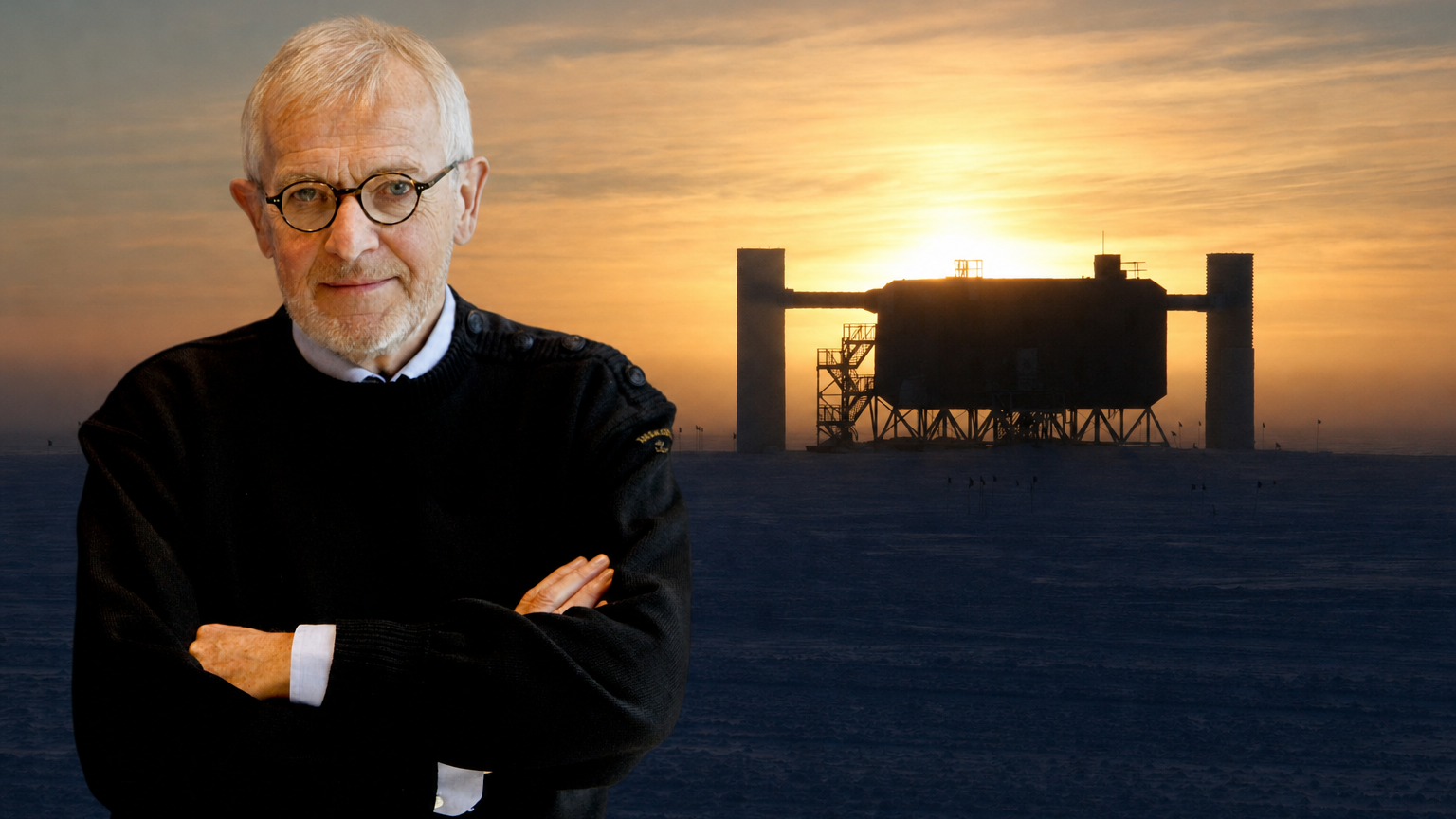
Francis Halzen, a Belgian-born physicist at the University of Wisconsin-Madison, received the 2026 Nobel Prize in Physics for his decisive contributions to the IceCube Neutrino Observatory and the discovery of high-energy neutrinos of astrophysical origin, according to the Royal Swedish Academy of Sciences. The academy highlighted how Halzen first proposed using Antarctic ice as a detection medium in 1988, a concept that evolved into a massive facility completed in 2011. His scientific leadership proved instrumental in creating an instrument that has transformed understanding of the universe’s most violent processes.
IceCube spans a full cubic kilometre of glacial ice embedded with more than 5,000 light sensors at depths of up to 2.5 kilometres, a New Scientist assessment found. Neutrinos, which rarely interact with ordinary matter and thus earn the nickname ghost particles, produce faint flashes of light upon collision that the sensors capture and trace back to their origins. Reuters reported that these particles provide direct information from events such as exploding stars or accreting black holes that other telescopes cannot observe.
The Nobel Prize organization noted that high-energy cosmic neutrinos occur so infrequently that only an enormous detector volume can register enough events for meaningful analysis. Halzen spearheaded an international effort involving more than 450 researchers from 58 institutions in 14 countries to bring the project to fruition, collaborative records show. Data from the observatory later confirmed neutrinos arriving from outside the solar system and even from within the Milky Way galaxy.
This award represents the second Nobel Prize unveiled in 2026, coming one day after the medicine category, CNN reported from Stockholm. The physics laureate receives 12 million Swedish kronor, roughly equivalent to $1.2 million, according to Reuters. The formal presentation by Sweden’s King Carl XVI Gustaf is scheduled for December 10 in the Swedish capital, the anniversary of Alfred Nobel’s death.
Previous neutrino research earned the 1995 Nobel Prize for Frederick Reines, who first detected lower-energy versions of the particles, a Scientific American overview recalled. Halzen’s achievement extends that legacy into high-energy astrophysics, enabling an entirely new branch of astronomy based on neutrino messengers. The observatory’s findings have already influenced studies of cosmic ray origins and extreme astrophysical environments.
Halzen, who earned his doctorate from KU Leuven in 1969, has served as the principal investigator for IceCube since its inception, biographical details from the NobelPrize.org site indicate. Nobel committee chair Mark Pearce described the observatory as a fantastic instrument made possible by Halzen’s tenacity and vision in remarks carried by multiple outlets. The work has laid foundations for multi-messenger astronomy that correlates neutrinos with electromagnetic signals and gravitational waves from the same cosmic events.