

 ع
ع


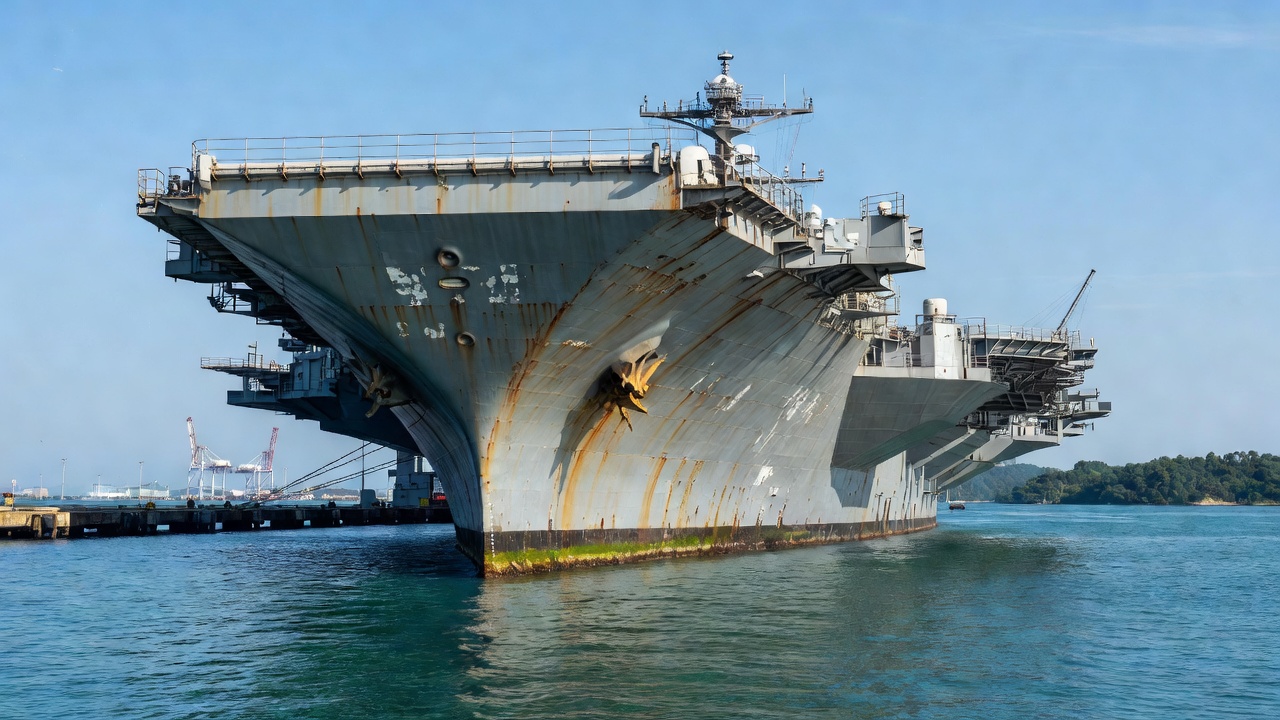
The nuclear-powered aircraft carrier USS Abraham Lincoln docked at Laem Chabang Port in Thailand this week displaying extensive rust streaks, faded paint and algae along its hull after nearly nine months continuously at sea. Reuters reported that the vessel, accompanied by the guided-missile destroyer USS Frank E. Petersen Jr. and cruiser USS Robert Smalls, had been relieved in the Middle East by the USS George Washington the previous month. Photographs distributed by the news agency showed similar wear on the escort ships, all of which had operated in harsh maritime conditions without extended breaks for preservation work.
The carrier left its homeport in San Diego on November 21, 2025, according to multiple accounts that place the total deployment at 286 days, one of the longest for a U.S. supercarrier in recent memory. A CNN assessment found the ship spent the majority of that period enforcing a naval blockade at the Strait of Hormuz and conducting combat operations tied to the U.S.-Israel conflict with Iran. Naval analysts cited in Reuters coverage noted that such sustained high-tempo activity left little room for routine maintenance that would normally occur during shorter port calls or scheduled yard periods.
Carl Schuster, a former U.S. Navy captain who completed three tours on Nimitz-class carriers, told CNN that rust along the waterline is not unusual on a ship that has spent 60 days or more of operations continuously at sea. Schuster explained that addressing the corrosion requires crews to be lowered over the side to sand, prime and repaint the affected areas, work that cannot be performed during combat deployments. He estimated that full preservation of the visible rust would require about 30 days in appropriate conditions, with priority given during the Thailand stop to the bow and forward hull sections that absorb the most abuse from saltwater and waves.
Newsweek reported that the carrier’s appearance, while striking for a symbol of American power projection, also reflects the vessel’s resilience after months of demanding operations far from home. William Freer, a research fellow at the Council on Geostrategy, told the publication that a ship commissioned in 1989 maintaining functionality through such an extended period without major mechanical issues demonstrates the Navy’s ability to push assets when required. Freer cautioned, however, that unchecked rust could eventually compromise watertight seals and necessitate more extensive shipyard repairs upon the carrier’s return to San Diego.
The prolonged deployment had already drawn attention to conditions aboard, with Reuters noting reports of mental health strain among the roughly 5,000 sailors and Marines, including complaints about food quality, mold in living quarters and mechanical breakdowns. Vice Admiral Joseph Cahill, commander of Naval Surface Forces, held a virtual meeting with crew families in early August to discuss the challenges, according to accounts in The Independent. At least one sailor attempted to jump from the ship upon arrival in Thailand, though two others were prevented from doing so, the newspaper added.
Thailand, designated a major non-NATO ally of the United States since 2003, has hosted the carrier for a five-day rest and recuperation visit that local officials expect will provide an economic lift to the nearby resort city of Pattaya. An Associated Press review of past port calls highlighted how such stops have historically combined shore leave with community service projects and military-to-military engagements between the two countries. The Abraham Lincoln is scheduled to depart Thailand later this week and continue its transit back to the West Coast following what Navy officials described as a well-deserved break for the crew.