ع
ع


Brussels wants secure European drones, local production and a trusted-drone label by the end of 2026. The harder problem is catching an industrial ecosystem that already gives Chinese manufacturers scale, components and speed.
Europe has stopped treating drones as an aviation niche. In February, the European Commission said the commercial airborne-drone segment alone could be worth about €14.5 billion by 2030 and exceed €50 billion by 2033, spanning construction, energy, transport, agriculture, emergency response and logistics. An earlier EU strategy estimated that the wider drone-services market could support 145,000 jobs by 2030, with inspection and surveillance among the civilian applications expected to become routine.
The numbers are attractive. The policy underneath them is more revealing. Europe is no longer asking only how many drones it can operate. It is asking how many of the systems, components and companies behind them it can trust and ultimately control.
Trust becomes industrial policy
The Commission’s February 2026 Drone and Counter Drone Security Action Plan calls for investment to scale European production, assessments of high-risk suppliers and an “EU Trusted” drone label scheduled for development by the fourth quarter of this year. The label is intended to use independent third-party verification and add product-level trust and resilience criteria to the existing cybersecurity framework.
The immediate rationale is security, particularly around airports, borders and critical infrastructure. Commercially, however, the implications travel much further. Energy companies, utilities, industrial operators and facilities managers increasingly use the same underlying drone technologies for inspection, monitoring, cleaning and maintenance. Once component provenance, cybersecurity and supplier risk enter procurement rules, “made in Europe” stops being simply a marketing line and starts becoming a potential purchasing advantage.
That is useful only if European suppliers can match the manufacturing ecosystem on the other side of the world.
Shenzhen shows the size of the gap
At the Drone World Congress in Shenzhen on 21 May 2026, more than 1,200 companies were exhibiting systems ranging from industrial lifting and infrastructure maintenance to anti-jamming technology. AFP described DJI as one of the dominant attractions and noted that studies with varying estimates have put the Shenzhen company at more than two-thirds of the global commercial drone market in recent years. Exhibitors also pointed to China’s extraordinary depth in components, where manufacturers can choose among large numbers of motors, magnets and other parts without rebuilding an upstream supply chain themselves.
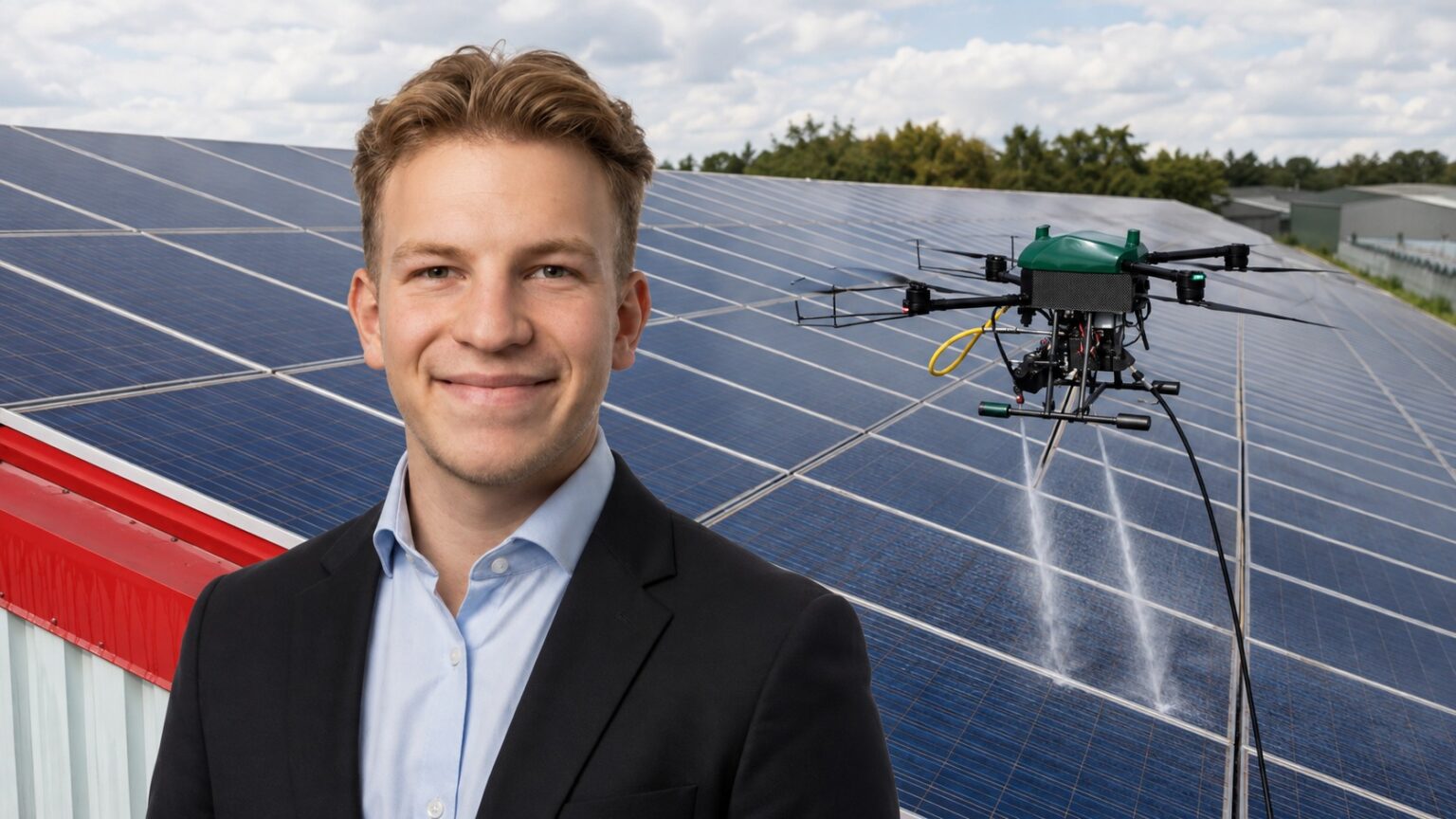
Among the Europeans walking those halls was DroneShine chief executive Luca Musiolik. The young German industrial-drone founder told AFP he had travelled to Shenzhen to study cleaning technologies. His assessment was unusually unvarnished: “You don’t really have any competitors in Europe or any innovation coming out of Europe.” He said DroneShine was looking to learn from Chinese technology in much the same way China once learned from German automotive manufacturing. The comments were published by AFP on 21 May 2026.
That is the European drone dilemma compressed into one trade-fair visit. Brussels wants technological sovereignty. European founders are still going to Shenzhen to see what industrial scale looks like.
The industrial drone rather than the flying camera
DroneShine is attempting to build from the application upward. Its German company was registered in Tübingen on 12 February 2026 with €25,000 in share capital and Luca Jann Musiolik and Fabian Luca Beck as managing directors. Its registered purpose is Robotics-as-a-Service using industrial drones for maintenance, cleaning, agricultural applications and work in hazardous areas.
That definition matters. The company is not positioning itself around selling another general-purpose aircraft. Its website describes drone systems developed in Germany for infrastructure cleaning, with applications including façades and solar installations, and claims its solar system can process up to 680 panels an hour through automated flight and integrated spraying. That throughput is company-reported.
The commercial model is therefore closer to industrial services than consumer hardware. At The smarter E Europe in Munich on 24 June, Musiolik appeared as DroneShine’s CEO in a session dedicated to solar O&M, inspection and AI-driven operations, presenting under the title “European Drones for a Sustainable Green Infrastructure.” It is precisely the sort of narrow civilian use case that could give European drone manufacturing an entry point without requiring a direct fight for the entire global airframe market.
Europe is not starting from zero
There is one important caveat. Musiolik’s suggestion that Europe lacks meaningful competitors or innovation is too sweeping, and DroneShine itself is still a very young company without a public financial track record. Switzerland’s Voliro already operates aerial robots for non-destructive industrial testing and says its systems are active in 17 countries, while Norway’s KTV Working Drone says its autonomous cleaning technology operates across 68 countries and handles more than 60 million square metres annually. The European problem is therefore less an absence of engineering than a shortage of companies operating at the manufacturing depth and commercial scale visible in China.
That distinction may determine whether the EU’s policy works. Europe does not need to reproduce Shenzhen component for component before it can build valuable drone businesses. It can compete first where regulation, specialist engineering and difficult physical work meet: inspecting structures, maintaining energy assets, cleaning buildings and taking people out of hazardous environments.
China currently owns much of the scale. Europe is beginning to write procurement rules around trust. Between those two facts sits the opening for companies such as DroneShine. The contest is no longer over whether drones will become industrial tools. It is over who gets to build the machines that Europe will allow near the infrastructure it considers essential.