

 ع
ع


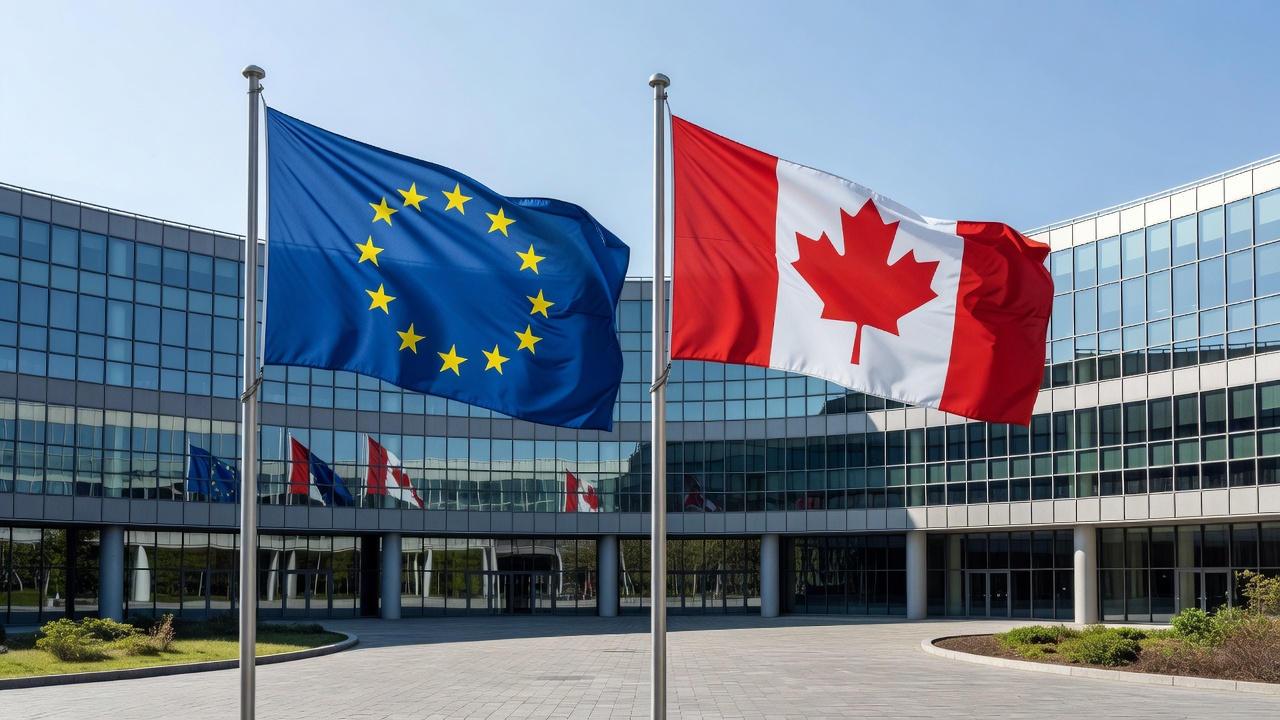
European Commission President Ursula von der Leyen proposed on Wednesday that the EU open the door for Canada to become its first associate member, a declaration made during her annual State of the Union address in Strasbourg with Canadian Prime Minister Mark Carney in attendance. The European Union has invited Canada to work toward the status to underscore growing closeness in a world of rising geopolitical risk, according to a New York Times report on the speech. Von der Leyen told lawmakers that partnerships represent a strategic choice for Europe while responding to fractures in the international rules-based system, and she emphasised how the EU and Canada see the world with the same eyes on topics from artificial intelligence to the Arctic.
The commission president directly addressed Carney in her remarks, stating she would like to work with him on the proposal as part of efforts to reimagine partnerships. She outlined an expanded alliance that would build on the existing Comprehensive Economic and Trade Agreement and cover areas including advanced manufacturing, technology, defence production, energy and critical minerals. Von der Leyen described the partnership as one for common strength rather than directed against others, a point echoed across reporting from Reuters and The Guardian on the address.
The associate membership concept does not yet exist under EU treaties, a Reuters assessment found, and it follows an earlier suggestion by German Chancellor Friedrich Merz in May for a similar interim status for Ukraine that would allow participation in institutions without voting rights. A Wall Street Journal report the previous week indicated Carney had been exploring the idea amid Canada’s interest in deepening European ties during trade tensions with the United States, according to an Euractiv summary of diplomatic discussions. Canadian officials have spoken of forging a unique alliance based on shared values and complementary strengths without pursuing full membership, The Globe and Mail reported.
Von der Leyen received a standing ovation after her announcement, after which she and Carney shook hands, multiple outlets including Bloomberg and The Irish Times observed from the event. The proposal envisions joint projects such as making the Arctic a flagship initiative alongside cooperation on batteries, quantum computing, cybersecurity and economic security. She framed the relationship as rooted in democracy, where power belongs to all rather than the strongest or richest, and stressed that democracies retain freedom to choose partners.
Canada and the EU already cooperate closely on Ukraine, defence, raw materials and supply chains, a point von der Leyen highlighted in her speech as evidence of alignment. A March 2025 poll showed nearly half of Canadians favour potential EU membership, Euractiv noted in its coverage of shifting public sentiment. Prime Minister Carney is set to address the European Parliament on Thursday, with a joint summit scheduled for the end of October in Montreal to advance discussions.
Negotiations over the precise terms of associate membership are likely to prove complex given that the designation requires defining new parameters for involvement, according to a Globe and Mail analysis published ahead of the address. The initiative aligns with Canada’s push to reduce dependence on any single trading partner while integrating further in sectors like intelligent manufacturing and research exchanges. EU diplomats have described Canada as sufficiently like-minded to warrant a tailor-made approach, an Euractiv interview with a senior official revealed.
The European Parliament is expected to play a role in shaping the parameters of any future agreement, building on the foundation of existing regulatory harmonisation seen in arrangements with non-EU European states. Carney has called for deeper trade, investment, security, data, academic and labour ties without sacrificing autonomy, The Globe and Mail reported from sources familiar with Canadian objectives. Further talks will determine the extent of any participatory mechanisms for Canada in EU decision-making processes.