ع
ع


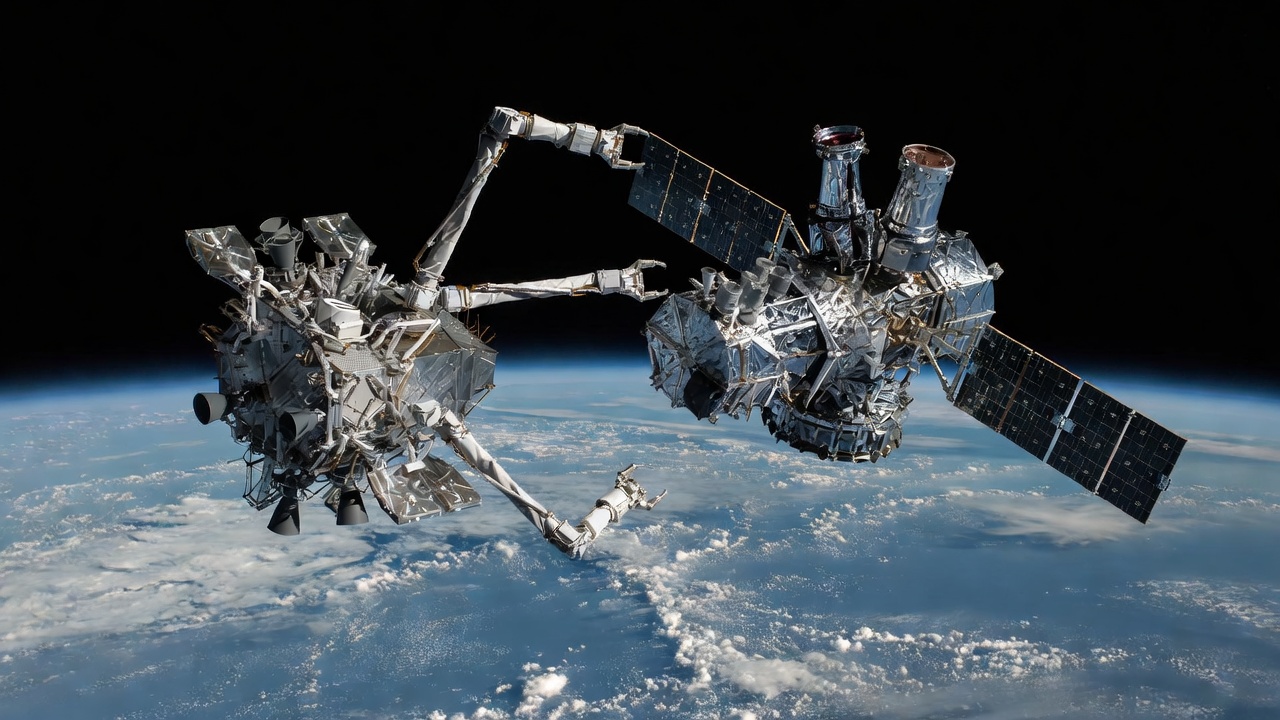
Robotic Spacecraft Set to Launch on Pioneering NASA Mission to Rescue Swift Observatory
NASA is scheduled to launch a robotic spacecraft as early as this week to boost the orbit of its Neil Gehrels Swift Observatory, which faces a 90 percent chance of uncontrolled reentry into Earth’s atmosphere by the end of 2026, the agency said on June 29, 2026. The $30 million mission will deploy a three-armed servicer developed by Katalyst Space Technologies to grapple the telescope and raise it approximately 200 kilometers higher, extending its operational life for several more years. The effort marks the first use of commercial technology for such an in-orbit rescue of a NASA science asset.
The Swift observatory, which NASA launched in November 2004, has detected more than a thousand gamma-ray bursts while delivering data that contributed to over 10,000 scientific papers, according to agency tallies. A Nature journal assessment found that the spacecraft, now more than two decades old, continues to supply valuable observations of cosmic explosions despite gradual orbital decay from atmospheric drag. NASA data places the current risk of an uncontrolled descent as high enough to warrant the urgent intervention.
Katalyst Space Technologies completed the LINK spacecraft in just nine months under a NASA contract, the startup said in a statement. The servicer will ride to space aboard a Northrop Grumman Pegasus XL rocket released from an aircraft over Kwajalein Atoll in the Marshall Islands before conducting an autonomous rendezvous with Swift. Once attached via its extendable arms, the combined spacecraft will fire thrusters to achieve the higher orbit, NASA technical descriptions state.
Agency officials selected the commercial route after determining that traditional alternatives would prove too costly and complex, a NASA briefing found. Success on the Swift Boost mission could serve as a template for future servicing operations, including potential applications for the Hubble Space Telescope whose orbit is also gradually declining, according to a CBS News report. The approach aligns with NASA’s broader push to leverage private-sector innovation for space sustainability.
Swift’s suite of instruments includes wide-field gamma-ray detectors alongside X-ray and ultraviolet telescopes capable of rapidly repositioning to study burst afterglows across multiple wavelengths, NASA mission overviews show. The observatory has played a central role in multi-messenger astronomy by alerting ground facilities and other space assets to explosive events, amplifying the scientific return from each detection. Engineers have performed extensive ground testing at Goddard Space Flight Center to validate the LINK grapple mechanism’s compatibility with Swift’s structure.
A successful orbit raise would allow Swift to maintain its contributions to transient-event studies at a fraction of the expense of designing and launching a replacement satellite, NASA estimates indicate. The mission also supports efforts to limit orbital debris by avoiding an uncontrolled breakup during reentry. Katalyst Space has described the technology as extensible to other government and commercial satellites approaching the end of their design lives, according to company announcements.
The LINK spacecraft will require several weeks after launch to reach Swift before executing the delicate attachment sequence under close monitoring from ground controllers, a NASA assessment found. Contingency procedures have been developed for various scenarios during the proximity operations and propulsion burns. If all phases proceed as planned, the observatory could remain scientifically productive well into the 2030s.