

 ع
ع


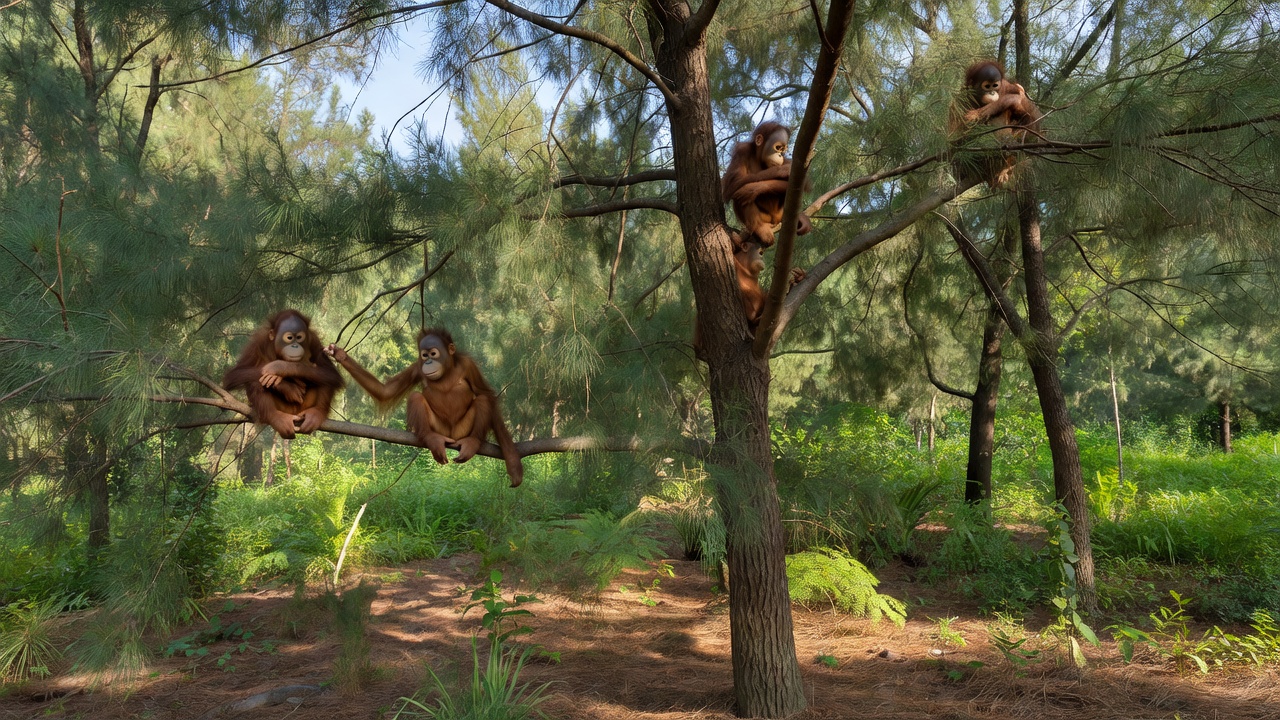
Local residents alerted forest officials after spotting the five orangutans swinging from branches in a casuarina plantation near Badapai village in Balasore district early on September 8 according to Balasore District Forest Officer Pratik Prakash Indalkar. The juveniles three males and two females measuring one to 1.5 feet tall received immediate first aid and oral rehydration solution before being transferred to Nandankanan Zoological Park in Bhubaneswar where they entered quarantine for health monitoring. Indalkar told reporters that four of the animals were eating well while veterinary teams continued to assess the fifth.
Odisha Forest and Environment Minister Ganesh Ram Singh Khuntia said the government suspects the orangutans were abandoned by an international smuggling racket after a failed transit operation and has asked the Wildlife Crime Control Bureau to examine entry routes. The minister noted that each animal carries a black-market value of 20 lakh to 25 lakh rupees and instructed checks of CCTV at airports ports and railway stations. A Special Task Force from the Odisha Police has sent investigators to Balasore to interview witnesses and collect evidence Deputy Inspector General Kanwar Vishal Singh reported.
Regional Chief Conservator of Forests Prakash Chand Gogineni stated that the primates could not have reached the site naturally because no ecological corridors link their Southeast Asian range to eastern India. The discovery site in the Udayapur-Talsari area lies close to a state highway and the West Bengal border increasing the likelihood of human transport. Forest teams have registered a case under the Wildlife Protection Act while zoo staff prepare for longer-term care pending approval from the Central Zoo Authority.
All three orangutan species are listed as Critically Endangered by the IUCN with a 2021-2023 range-wide survey estimating 11,694 Sumatran individuals across eight meta-populations and only 716 Tapanuli orangutans. A parallel assessment placed the Bornean population at roughly 104,700 though all three have experienced substantial declines driven by habitat loss and illegal collection. According to TRAFFIC data at least 161 live orangutans were seized in Indonesia Malaysia and Thailand from 2013 to July 2023 with juveniles preferred for the pet trade comprising more than half the total.
The United Nations Office on Drugs and Crime’s 2024 World Wildlife Crime Report placed primates among key taxa in a criminal economy estimated at billions of dollars annually noting that seizures represent only a fraction of actual movements. A Frontiers in Conservation Science article from 2024 found that primates accounted for 20 percent of illegal mammal confiscations in air transport between 2009 and 2017 underscoring the role of organised networks. CITES records indicate that legal trade in live primates exceeded 337,000 individuals from 2015 to 2021 yet illegal flows continue to threaten slow-reproducing great apes.
The rescued orangutans have remained stable under observation at Nandankanan Zoological Park as the joint state and national investigation proceeds without reported arrests to date. Officials continue to trace potential smuggling pathways while ensuring the animals receive species-appropriate care in line with central protocols. The case has drawn renewed focus on enforcement gaps that allow protected wildlife to move undetected across borders.