
 ع
ع


Global art sales grew 4 percent to $59.6 billion in 2025 and fairs took their largest share of dealer trade since 2022. The route Younes Khourassani’s work has travelled in eighteen months, from Marrakech to Cape Town to Geneva, offers one example of how Moroccan artists are reaching wider international audiences.
The global art market ended two years of contraction in 2025. Sales rose 4 percent to an estimated $59.6 billion, according to the Art Basel and UBS Global Art Market Report 2026, prepared by Arts Economics, the first annual growth recorded since 2022. Dealer sales advanced 2 percent to $34.8 billion, public auctions gained 9 percent to $20.7 billion, and online sales fell to $9.2 billion, their lowest level since 2019. The market that returned is an in-person market, and it travels.
For Moroccan painter Younes Khourassani, that return to physical circulation has coincided with an unusually international eighteen months.
The fair data carries the point. Art fair sales climbed to 35 percent of dealer turnover in 2025, up from 31 percent a year earlier and the highest share since 2022, and 63 percent of those fair sales were made at overseas events rather than in dealers’ home markets. Mid-sized galleries, those with turnover between $1 million and $10 million, recorded the sharpest rise, from 29 percent of sales made at fairs to 36 percent. For galleries outside the major auction centres, the implication is straightforward: overseas fairs are again an important route to buyers, particularly for mid-sized dealers whose share of sales made at fairs rose sharply in 2025.
The Casablanca Lineage on the Circuit
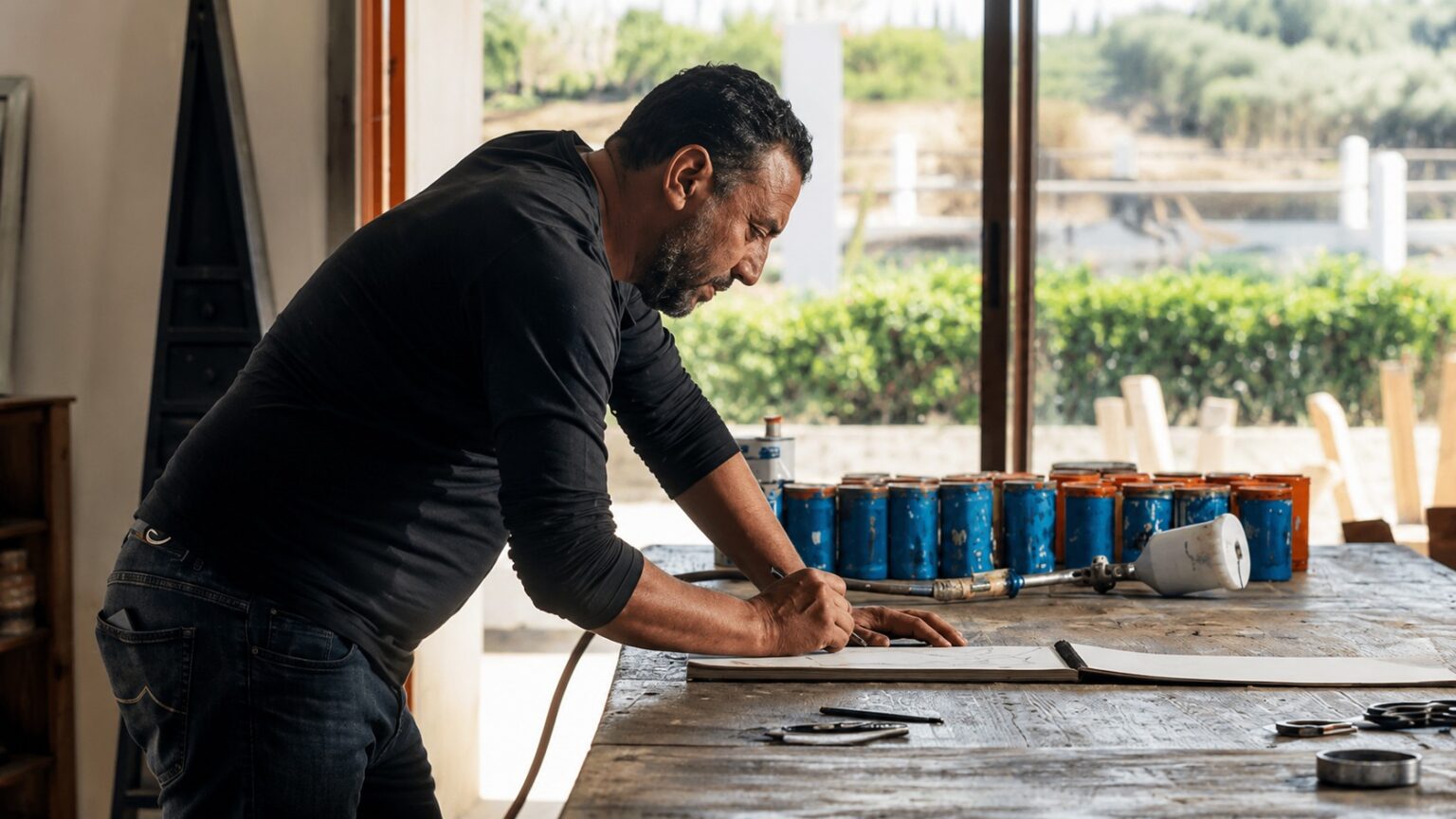
Few recent careers map onto that shift as cleanly as Khourassani’s. Born in Casablanca in 1976, Khourassani graduated from the École Supérieure des Beaux-Arts de Casablanca in 2001. La Galerie 38 has described him as a pupil of Mohamed Hamidi, one of the major figures of the Casablanca School. Over time, Khourassani’s work moved toward geometric compositions built around colour, light and optical rhythm.
That lineage was on display, and on sale, at the 1-54 Contemporary African Art Fair at the end of January 2025, the Africa-focused fair that has become an important fixture in Marrakech’s contemporary-art calendar. La Galerie 38, the Casablanca gallery whose programme includes Khourassani, presented him at La Mamounia alongside Moroccan artists working across different generations of abstraction. The Art Newspaper reported that the gallery sold three works from the stand, among them an untitled 2025 painting by Khourassani for around €13,000.
Eighteen Months, Three Cities
What followed tracks the report’s geography almost line by line. In February 2026, Eclectica Contemporary in Cape Town opened Energies of Light: Chromatic Journeys Between Heat and Infinity, a solo exhibition dedicated to Khourassani’s painting. In May he was among six Moroccan artists in Géométries Marocaines, a survey of Moroccan geometric abstraction that ran at La Galerie 38’s Geneva space until 27 June.
The Geneva address is itself part of the story. La Galerie 38, founded in Casablanca in 2010, opened a second space in Marrakech in 2023 and a third in Geneva in April 2025, in the Quartier des Bains district where the city’s galleries and institutions cluster. The permanent Geneva space reflects the same internationalisation seen in the fair data, but through fixed infrastructure rather than temporary events. It places a Moroccan programme year-round inside Geneva’s established gallery district, while Khourassani arrives with an exhibition history already spanning London, Paris, Brussels, Kuwait, Egypt and Morocco.
What One Sale Proves, and What It Does Not
The honest limit of the evidence belongs in the account. A single publicly reported fair sale at around €13,000 is a data point, not a price history, and the case for Khourassani’s recent momentum rests on circulation rather than evidence of sustained price appreciation: the number of cities his work reached in eighteen months, not an ascending price curve. The market carrying that circulation, for all of last year’s growth, also remains below its 2022 peak.
Circulation, though, is one of the clearest themes running through the 2026 report. Fair sales strengthened, higher-value transactions shifted back toward in-person channels, dealers earned the majority of their fair income abroad, and 43 percent of galleries expect sales to improve further this year. Moroccan gallery infrastructure is also becoming more internationally connected, through overseas spaces, participation in fairs such as 1-54 and Art Genève, and exhibitions that carry Moroccan artists beyond the domestic market. In eighteen months, Khourassani’s work moved from La Mamounia to Cape Town to Geneva. For him, international circulation is no longer theoretical. It now has dates, cities and exhibitions attached to it.