ع
ع


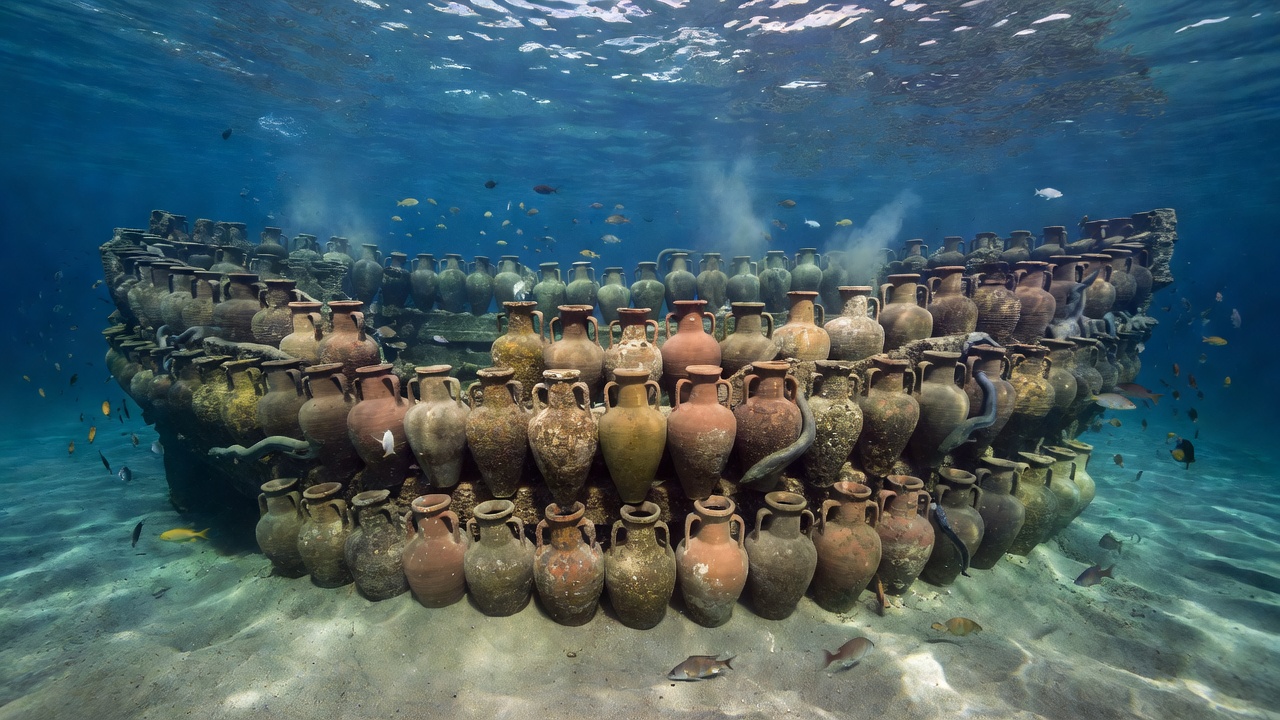
The wreck measures six metres across and lies piled with well-preserved ceramic jars once used to transport wine, olive oil and grain, according to details provided by Italian authorities following the diver inspection. Fisherman and free-diver Giacomo De Mola reported the site after fishermen tipped him off to an unusual seabed formation in the waters off Sicily. The Carabinieri Art Squad, the specialist police unit responsible for cultural heritage protection, deployed its divers to the location and verified the presence of the merchant vessel dating back more than 2,000 years.
De Mola recounted his approach to the anomaly in an interview after the find. “I get closer. And my heart stops. It wasn’t a rock,” he said. He described the moment as “the most incredible discovery of my life” and noted the challenge of conveying what it felt like to stand among the first humans in nearly 20 centuries to witness the place, while observing eels, snappers and countless marine life now inhabiting the jars.
Culture Minister Alessandro Giuli described the wreck as one of the most important underwater archaeological discoveries of recent years in comments released after the initial assessment. Officials have put safety measures in place to safeguard the site during ongoing investigations into its precise age, construction and cargo contents. The discovery process began when De Mola shared video footage showing the amphorae field on the seabed.
Maritime archaeologists have identified nearly 1,800 ancient shipwrecks in the Mediterranean and Black Sea since systematic surveys intensified in the 1980s, a review in the Journal of Marine Science and Engineering reported. The Oxford Roman Economy Project database has catalogued around 600 additional wrecks discovered since 1992, many from the Roman era when maritime trade reached peak intensity. These cumulative finds continue to expand understanding of ancient shipping patterns across the region.
Amphorae remain among the most valuable artefacts for reconstructing Roman commerce because their shapes, stamps and residues reveal cargo origins, destinations and the scale of trade networks, according to a 2025 analysis by researcher P. Komar published in the Journal of Archaeological Science. That study of more than 28,000 diagnostic fragments from 66 Italian sites showed the highest market integration and product diversity during the late Republican and early Imperial periods, followed by a marked decline after 200 CE. The containers’ tapered bases also allowed secure stacking in curved ship hulls, facilitating long-distance maritime logistics that sustained the empire’s economy.
A comparable 1st or 2nd century BC vessel laden with hundreds of amphorae was located northwest of Rome in 2023, while a Greek merchant ship more than 2,400 years old was found intact off the Bulgarian coast in 2018, Italian authorities noted in contextual remarks on the Sicilian discovery. The latest find near Mazara del Vallo adds fresh data points to this inventory at a time when remote-operated vehicles and improved diving techniques have accelerated underwater surveys. Further laboratory examination of the amphorae is expected to clarify the ship’s intended route and the specific commodities it carried at the time of its loss.