

 ع
ع


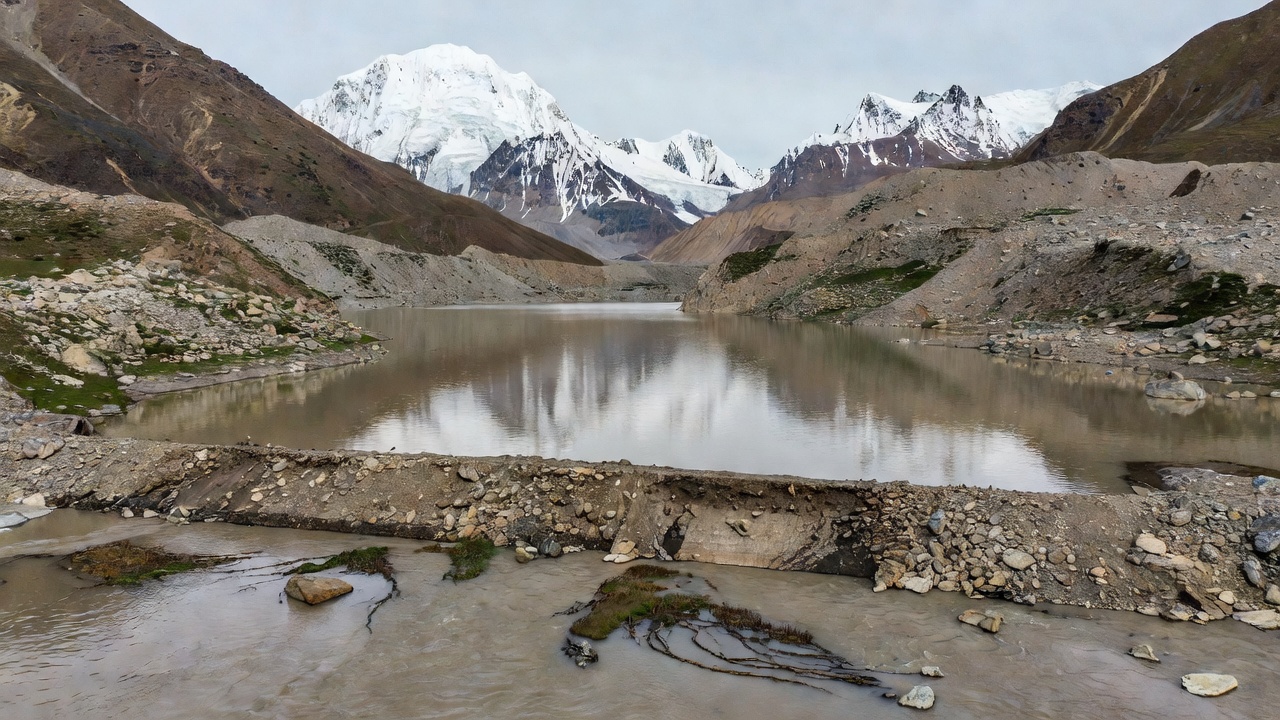
China’s Ministry of Water Resources has warned of a high risk that a barrier lake formed after a glacier collapse could breach and unleash a second major flood, with 2.5 million cubic metres of water already accumulated by Friday morning and a further 3 million cubic metres expected to flow in through the weekend. The lake at the confluence of the Chhochen Khola and Purepu Tsangpo rivers began overflowing amid heavy rainfall that has destabilised surrounding slopes, prompting authorities to run flood simulations and prepare mitigation measures. An eight-member engineering team dispatched to the site is monitoring water levels, lake floor conditions and weather forecasts as rain is projected to continue for at least another week.
State broadcaster CCTV reported that all Chinese rescue personnel and vehicles have withdrawn to a safe area roughly seven kilometres from Gyirong Port, suspending operations because of the threat of fresh flooding or debris flows. The move follows the initial glacier collapse on August 26 near Langtang Lirung peak that sent rock, ice, mud and debris surging downstream into river systems on both sides of the border. Aerial footage released by rescue teams showed masses of brown water accumulating against a natural debris dam with submerged vegetation visible along its edges.
Nearly 1,000 people remain missing across the affected valleys while the confirmed death toll stands at 362, according to multiple accounts compiled by Reuters. More than 550 of the missing are on the Chinese side, with nearly half of them foreigners, while Nepali teams have recovered scores of bodies from the Narayani River alone. Search efforts continue in debris-strewn terrain even as both governments urge extreme caution in the flood-prone zones.
Nepal’s disaster management authority issued a notice urging residents, passengers and rescuers to stay away from the banks of the Bhote Koshi, Trishuli and Narayani rivers until the danger subsides. “Residents of the lower banks… passengers, rescuers engaged in rescue operations, and all concerned are requested to exercise special caution and stay in safe places away from the river banks and risky areas,” the authority said. The initial flood and subsequent lake formation have compounded longstanding vulnerabilities in a region where river systems originate in Tibetan glaciers before descending into Nepali valleys.
The International Centre for Integrated Mountain Development has documented more than 700 glacial lake outburst floods across High Mountain Asia between 1533 and 2025, events that have claimed nearly 9,000 lives in total. Its database shows that 54 percent of these outbursts were triggered by mass movements such as avalanches or landslides while impacts on infrastructure have risen more than threefold in recent updates, reflecting both improved reporting and growing exposure from new roads, settlements and hydropower projects at higher elevations. Climate-driven glacier retreat has expanded existing lakes and created new ones, elevating the overall hazard in the eastern Himalayan sector where peak discharges can rival those of major monsoonal rivers far downstream.
Chinese authorities have activated a Level-IV natural disaster alert for the Tibet Autonomous Region while coordinating with Nepali counterparts on real-time data sharing and potential downstream impacts. Earlier inventories of glacial lakes in adjacent Indian Himalayan basins have identified hundreds showing notable expansion, underscoring a regional pattern that scientists link to accelerated warming. Officials on both sides continue to update risk assessments as the barrier lake volume evolves, with projected peak flows from a possible breach centred around September 1.