ع
ع


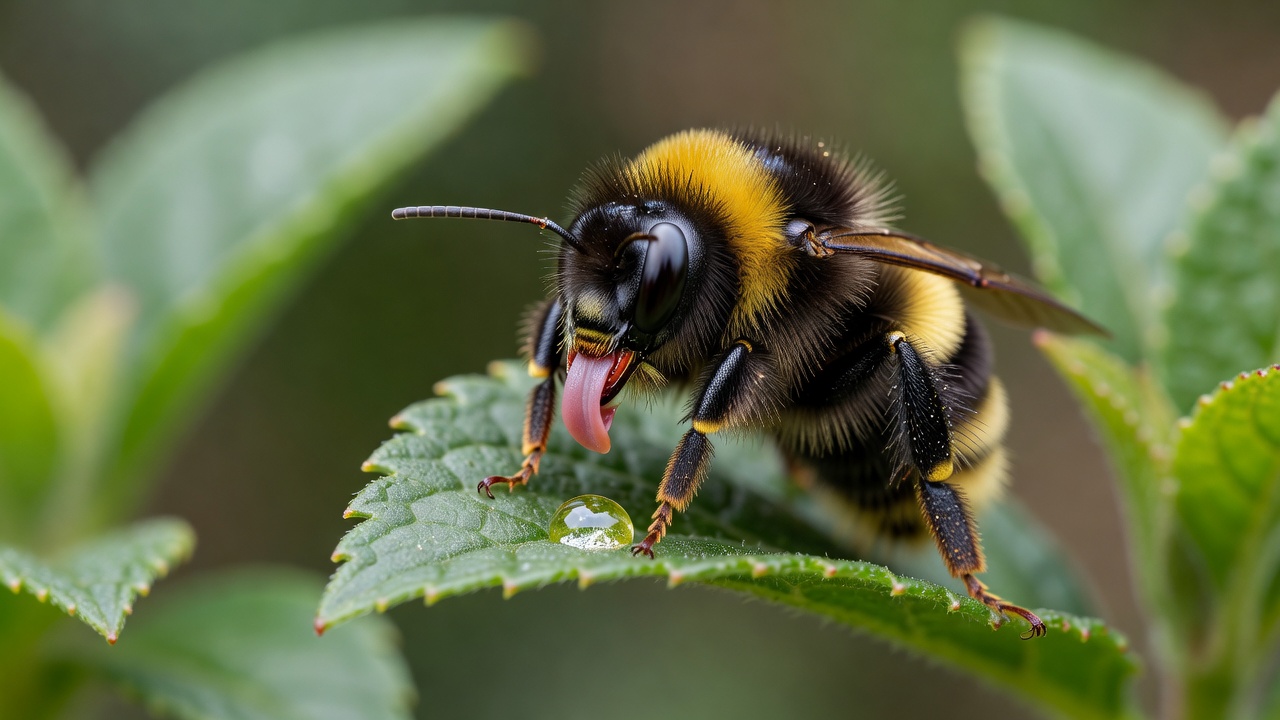
A study published this week in the Proceedings of the National Academy of Sciences documented bumblebees extending their tongues after consuming sugar solutions in a behaviour researchers likened to lip licking while shaking their heads and wiping their mouths after bitter or salty tastes. Professor Andrew Barron of Macquarie University who co-authored the paper stated that these responses occurred under normal conditions as post-consumption glossa where bees continued licking after finishing the sweet droplet. The work conducted with Southern Medical University in China used high-speed video to capture the miniature facial expressions which the team interpreted as evidence of affective evaluation previously associated only with mammals according to the university’s summary of the findings.
The Macquarie University assessment found the behaviours consistent with liking and disliking responses seen in other animals although Barron cautioned in an institutional article that the results do not prove bees experience human-style emotions. Instead the data adds to accumulating research suggesting insects may possess forms of subjective experience. Publication of the paper on July 8 2026 has revived public discussion framed by some outlets as the question of whether bees have feelings and what that means for understanding their inner life.
Earlier investigations have similarly pointed to emotion-like states in bees. A Newcastle University study released in October 2024 showed that bumblebees subjected to simulated predator attacks subsequently displayed pessimistic decision-making by opting more frequently for lower-value rewards. Researcher Olga Procenko who led that work told the university that the shift toward pessimism indicated bees may experience emotion-like states when stressed in a pattern comparable to responses in humans and other vertebrates.
University of Arizona entomologist Stephen Buchmann detailed in his 2023 book that bees demonstrate traits resembling optimism frustration and fear while also recognising individual human faces and processing memories during sleep. The Guardian reported on Buchmann’s conclusion that bees are self-aware sentient and possibly endowed with a primitive form of consciousness. Such claims have gained traction with the New York Declaration on Animal Consciousness which lists insects among taxa where evidence supports potential conscious experience according to multiple scientific summaries of the document.
Professor Barron noted in remarks carried by Macquarie University that the latest findings build on a wave of research daring to examine insect inner lives including evidence that bees can learn from one another and display avoidance behaviours after negative events. The 2026 paper specifies that reactions varied by solution strength with the strongest positive responses reserved for high-sugar concentrations and aversive grooming most pronounced after quinine exposure. Further replication across species will be required to determine how widely these capacities exist the professor added.
Bees play a central role in agricultural economies through pollination services that sustain crop yields worldwide according to assessments from the Food and Agriculture Organization of the United Nations. Recognition of potential sentience in these insects could influence future practices in commercial beekeeping and pest management the accumulating literature suggests. Additional research cited by the Royal Society in a 2025 review has explored related cognitive functions such as attention prediction and active sleep in insects all of which contribute to ongoing debates about the evolutionary origins of consciousness.