




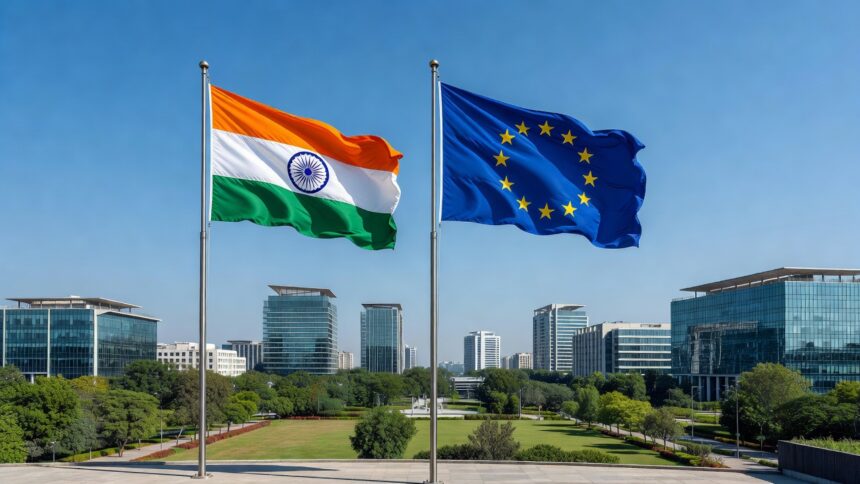
India and the European Union announced a landmark free trade agreement on January 27, 2026, that officials described as creating a free trade zone encompassing two billion people and roughly one quarter of global gross domestic product. Prime Minister Narendra Modi and European Commission President Ursula von der Leyen made the announcement in New Delhi after concluding negotiations that had stretched nearly two decades, with the pact set to deliver benefits across multiple economic sectors for both sides. The agreement is projected to double EU exports to India by 2032 while generating annual duty savings of around 4 billion euros for European companies, according to statements from EU officials.
The deal will eliminate or reduce tariffs on 96.6 percent of EU goods exports to India by value, EU officials said in the announcement covered by Al Jazeera. This includes zero or lowered tariffs on machinery, chemicals, pharmaceuticals and almost all aircraft and spacecraft, while automobile tariffs will phase down to 10 percent under a quota of 250,000 vehicles per year. Tariffs on EU wine will drop to between 20 and 30 percent, with spirits at 40 percent and beer at 50 percent, and processed foods and fruit juices will see tariffs removed entirely, the officials added. European service providers stand to gain privileged access in areas such as financial services and maritime transport under the terms detailed in the pact.
India will benefit from the EU cutting tariffs on 99.5 percent of its goods over a seven-year period, including duty-free access for marine products, leather, textiles, chemicals, rubber, base metals and gems and jewellery, according to India’s trade ministry as reported by Reuters. Modi said the agreement would open opportunities in textiles, gems and jewellery, and leather goods for India’s population. European Commission figures show bilateral trade in goods reached 118 billion euros in 2025, reflecting an 83.7 percent increase over the past decade, with trade in services adding 67 billion euros in 2024.
A Kiel Institute assessment found the trade deal would produce mutual economic gains of between 0.12 and 0.13 percent of GDP for both partners while increasing bilateral trade volumes by 41 to 65 percent. The analysis placed the agreement in the context of India’s efforts to offset the impact of substantial US tariffs. EU foreign direct investment stock in India stood at 132.8 billion euros in 2024, according to European Commission data, underscoring the depth of existing economic ties that the new pact is expected to expand.
Negotiations for the free trade agreement originally launched in 2007 but advanced rapidly only after a 2022 relaunch prompted by Russia’s invasion of Ukraine and subsequent geopolitical shifts, Al Jazeera reported. The timing coincides with US tariff policies and Chinese export controls that have encouraged both parties to strengthen alternative trade channels, officials indicated. Last-minute discussions addressed the EU carbon border tax on steel, yet the final deal preserves the mechanism while allocating 500 million euros in EU support for India’s emissions reduction efforts, Reuters reported.
The announcement also included the launch of a security and defence partnership between the EU and India, modelled on similar arrangements with Japan and South Korea, von der Leyen stated. India will gain a duty-free steel export quota of 1.6 million metric tons to the EU annually, equivalent to about half its current shipments to the bloc, Reuters reported. The moves reflect broader attempts by both sides to diversify partnerships and reduce reliance on single suppliers for critical goods and technology.
Deepanshu Mohan, professor of economics at OP Jindal Global University near New Delhi, told Al Jazeera that the agreement represented a fresh hope for expanding trade that is already significant between the two economies. “It’s an important deal for the simple reason that India trades a lot with the EU,” Mohan said. “A lot of the trade happens in goods, merchandise which India would technically want to expand given its high tariffs with the US.” He noted the potential for job creation in labour-intensive sectors and new opportunities for European businesses amid economic pressures in the region.