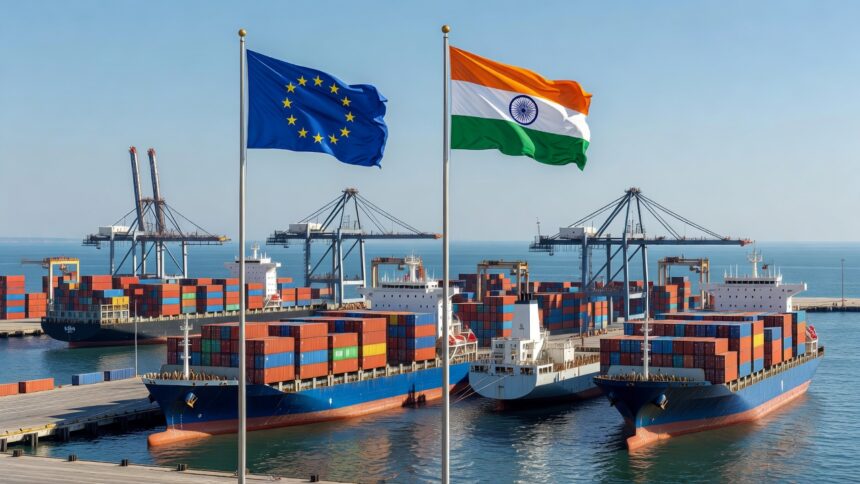
EU and India Conclude Largest Ever Free Trade Agreement Negotiations
The European Union and India concluded negotiations for a major free trade agreement on January 26, 2026, in a move expected to substantially boost commerce between the two economies amid geopolitical challenges. The pact, termed the largest ever for both parties by the European Commission, will create a free trade zone encompassing nearly 2 billion people and is projected to double EU goods exports to India by 2032 while saving European exporters around 4 billion euros in duties annually. European Commission President Ursula von der Leyen described the deal as a historic deepening of partnership between the world’s largest democracies that signals the continued value of rules-based cooperation.
The announcement issued by the European Commission highlighted how the agreement grants EU firms tariff reductions unmatched by any of India’s other trading partners. Tariffs on automobiles will decline gradually from 110 percent to 10 percent, with complete removal on auto components after five to 10 years. Duties on machinery up to 44 percent, chemicals at 22 percent and pharmaceuticals at 11 percent will be largely phased out, providing competitive advantages to key industrial sectors. The deal also features provisions to assist small and medium-sized enterprises in navigating the new opportunities through dedicated contact points and information resources.
According to the Commission’s statement, the FTA will significantly open the Indian market for European agri-food products by reducing often prohibitive tariffs that average more than 36 percent. Specific cuts include lowering wine duties from 150 percent to as low as 20 percent over time, eliminating olive oil tariffs from 45 percent to zero within five years and removing up to 50 percent duties on items such as bread and confectionery. Sensitive European agricultural goods including beef, chicken, rice and sugar have been excluded from any liberalisation to shield domestic producers. In tandem, separate talks on protecting geographical indications continue to prevent imitation of iconic EU food and drink products.
The agreement further extends to services and intellectual property, offering EU companies privileged entry to Indian markets in financial services and maritime transport under commitments that surpass India’s previous accords. It establishes robust protections for copyrights, trademarks, designs, trade secrets and plant varieties while harmonising certain legal frameworks between the two sides. European Commission data places current bilateral trade in goods and services above 180 billion euros per year, a figure that supports close to 800,000 jobs across the EU.
A Kiel Institute for the World Economy assessment projected that the FTA could increase bilateral trade volumes by 41 to 65 percent, delivering GDP gains of 0.12 to 0.13 percent for each partner. European Commission figures show goods trade alone reached 120 billion euros in 2024, with EU exports to India at nearly 49 billion euros, having expanded by almost 90 percent over the previous decade. Negotiations originally began in 2007 but were paused in 2013 before resuming in 2022, culminating in a final round in October 2025.
The pact incorporates a comprehensive trade and sustainable development chapter that strengthens commitments on environmental safeguards, climate action, workers’ rights and gender empowerment. Both parties will launch an EU-India climate cooperation platform in the first half of 2026, supported by up to 500 million euros in EU funding over the coming two years to aid India’s emissions reduction and sustainable industrial shift. The Commission stated that the chapter ensures effective implementation through dialogue and cooperative mechanisms.
Following the announcement, the draft texts will be published and subjected to legal scrutiny and translation into all EU official languages. The Commission will subsequently submit a proposal to the Council for approval of signature and conclusion of the agreement. Ratification by the European Parliament and Indian authorities will then be required before the FTA can take effect, a process that builds on the substantial existing economic interdependence where the EU serves as India’s third-largest trading partner.