





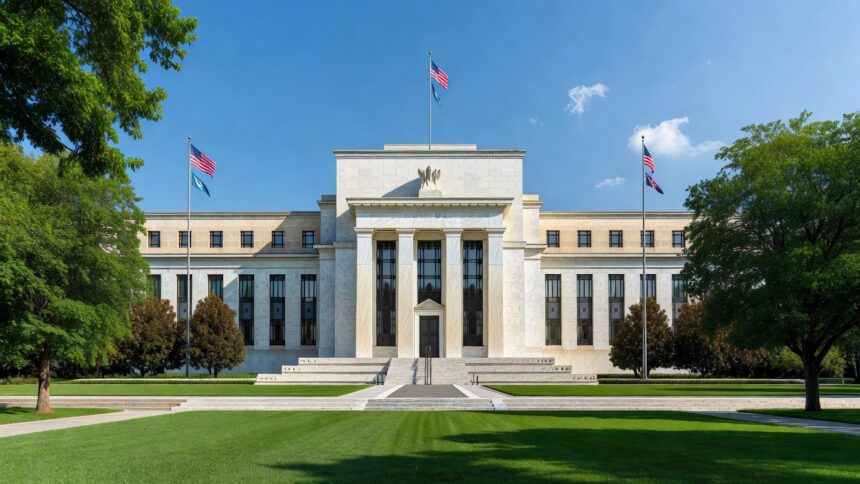
Alan Greenspan, Federal Reserve chairman from 1987 to 2006 under four presidents, died on Monday at the age of 100. His wife Andrea Mitchell announced that he died from complications of Parkinson’s disease and called him a giant in shaping the economy across multiple administrations, according to NBC News.
Mitchell’s statement released Monday described Greenspan as a figure who influenced American economic policy for decades while readily admitting errors when they arose. CNN reported that the economist passed away at the couple’s home, ending a career that stretched from the late Cold War into the digital era. The former Fed chair is survived by Mitchell, his wife of 29 years, who noted his impact in her capacity as an NBC News correspondent.
Born on March 6, 1926, in New York City, Greenspan first trained as a clarinetist at the Juilliard School and performed with jazz bands before shifting to economics, according to multiple biographical accounts including those published by The New York Times. He earned degrees from New York University and later embraced free-market principles after encountering the writings of Ayn Rand in the 1950s. Greenspan advised Republican presidential candidate Richard Nixon in 1968 and subsequently headed the Council of Economic Advisers, a Treasury Department summary of his career noted.
Reagan nominated Greenspan to lead the Federal Reserve in 1987, launching a tenure that spanned five terms and four presidents, Federal Reserve historical records show. He responded to the October 1987 stock market crash by injecting liquidity, an approach he repeated during later disruptions including the Gulf War and the 1995 Mexican peso crisis. During the 1990s expansion under President Clinton, real GDP grew at an average annual rate of 3.6 percent, according to a Joint Economic Committee analysis of that era’s performance.
Federal Reserve data places average inflation under Greenspan near 2.5 percent, a marked improvement from prior decades, while a Reuters review of Fed chairs since 1987 found his era produced an average unemployment rate of roughly 5.6 percent. Greenspan coined the term “irrational exuberance” in a 1996 speech to warn of overvalued asset prices, yet critics including economist Paul Krugman later argued that sustained low interest rates after the 2001 terror attacks helped inflate the housing bubble. In 2008 congressional testimony, Greenspan conceded a flaw in his assumptions, stating, “I have found a flaw. I don’t know how significant or permanent it is. But I have been very distressed by that fact.”
Greenspan received the Presidential Medal of Freedom from President George W. Bush in 2005 and an honorary British knighthood for his service, White House archives confirm. He continued offering economic commentary into his 90s, including critiques of later fiscal policies, and authored the 2007 memoir The Age of Turbulence detailing his experiences. A Federal Reserve staff paper credited the Volcker-Greenspan period with achieving price stability that supported reduced volatility in economic activity through the early 2000s.