ع



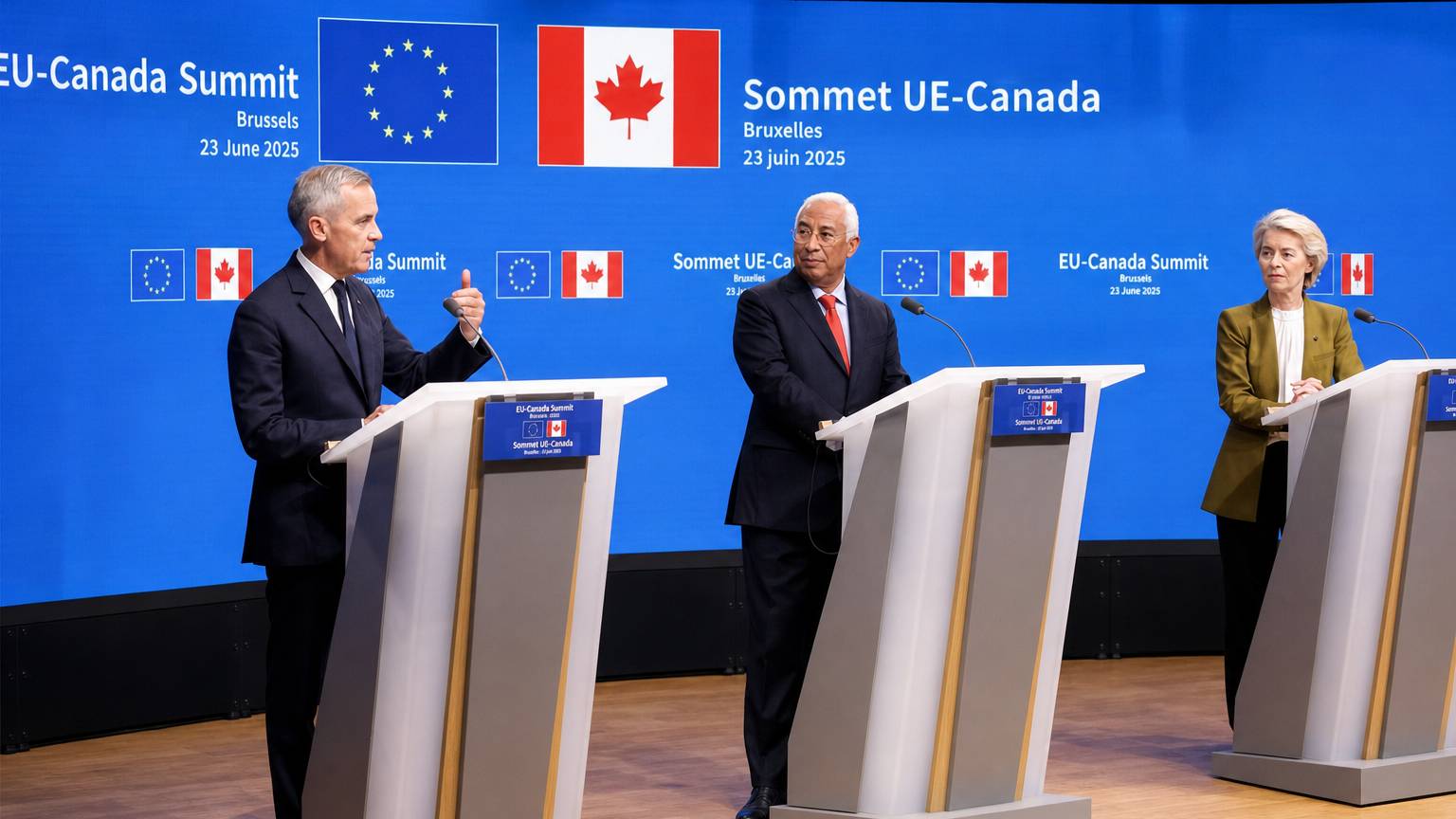
The Prime Minister of Canada’s office has announced that Mark Carney will host European Council President António Costa and European Commission President Ursula von der Leyen at the Canada-EU Summit in Montréal from October 29 to 30, 2026. According to the announcement, discussions will focus on leveraging complementary strengths with the EU providing market power, research depth and manufacturing while Canada contributes abundant energy, critical minerals, expertise in artificial intelligence, quantum computing and a robust banking system. Carney aims to convert these assets into tangible benefits for people on both sides of the Atlantic, building on Canada’s recent membership in the EU SAFE initiative that has already unlocked defence industry opportunities and his participation as the first non-European leader at the European Political Community Summit.
A joint declaration for the summit commits both sides to ever closer association but omits the contentious term of Canada as an associate EU member following opposition from Germany and other countries that questioned its lack of legal basis, a Reuters report from October 28 detailed. Carney told reporters earlier that the specific name matters less than the real-world improvements it delivers for Canadians and their families. The document also calls for continued work to define the relationship ahead of another summit next year while incorporating joint initiatives on subsea cable infrastructure to improve connectivity between Europe, Canada and Asia.
Bilateral trade in goods and services between Canada and the EU reached $178.3 billion in 2025, with merchandise trade expanding more than 78 percent since the provisional application of the Comprehensive Economic and Trade Agreement, Global Affairs Canada figures show.[[1]](https://www.canada.ca/en/global-affairs/news/2026/10/minister-sidhu-to-join-eu-counterparts-in-ireland-to-build-on-cetas-success-and-unlock-new-opportunities-for-canadian-businesses.html) A TD Economics assessment placed the EU share of Canadian merchandise exports at roughly 5 to 6 percent, indicating substantial potential for further growth even as early 2026 data recorded a nearly 21 percent rise in Canadian shipments to the bloc.[[2]](https://economics.td.com/ca-canada-eu-trade) The partners have identified critical minerals as a priority area, with Canada ranking among top global producers of materials essential for the energy transition that can help address Europe’s supply needs.
Upon landing in Montreal, Ursula von der Leyen stated that the summit would begin talks on making Canada the first associate member of the EU while pursuing the closest partnership ever with a non-European country, according to an AFP report published October 29.[[3]](https://www.afp.com/en/eu-canada-build-new-chapter-alliance-montreal-summit) “A new chapter in our shared history starts in Montreal,” she said. The declaration further includes a feasibility study on Canadian liquefied natural gas shipments to Europe alongside commitments to align on digital regulations and multilateralism that could create friction with Washington.
Carney has long advocated for deep cooperation across strategic capabilities including defence industrial capacity, artificial intelligence, space and payments to enhance collective resilience rather than pursue self-sufficiency, as detailed in his September 2026 address to the European Parliament covered by The Guardian.[[4]](https://www.theguardian.com/world/2026/sep/17/mark-carney-deep-cooperation-canada-eu-strasbourg) An EU official, speaking anonymously, described the emerging framework as one that would align policies on climate, energy and artificial intelligence while enabling Canadian participation in select EU programs under a shared governance structure, AFP reported. Eurostat data places total goods trade at €81.8 billion in 2025, with the EU maintaining a surplus as exports of machinery, pharmaceuticals and vehicles outpaced imports of ores and mineral fuels.[[5]](https://www.brusselstimes.com/2352365/eu-canada-trade-hits-e81-8-billion-but-imports-surge-four-times-faster)
The Montreal gathering continues momentum from a 2025 enhanced strategic partnership and security accord while responding to geopolitical shifts including U.S. tariffs that have accelerated Canada’s diversification efforts, Policy Magazine analysis noted.[[6]](https://www.policymagazine.ca/our-policy-series-on-the-canada-eu-relationship/) Officials from both sides have stressed the importance of securing concrete deliverables over the coming year before Europe’s political calendar shifts. The summit occurs against a backdrop in which Canada-EU merchandise trade has grown faster than Canada’s overall global commerce, underscoring the value of deepening an alliance of like-minded democracies.