ع
ع


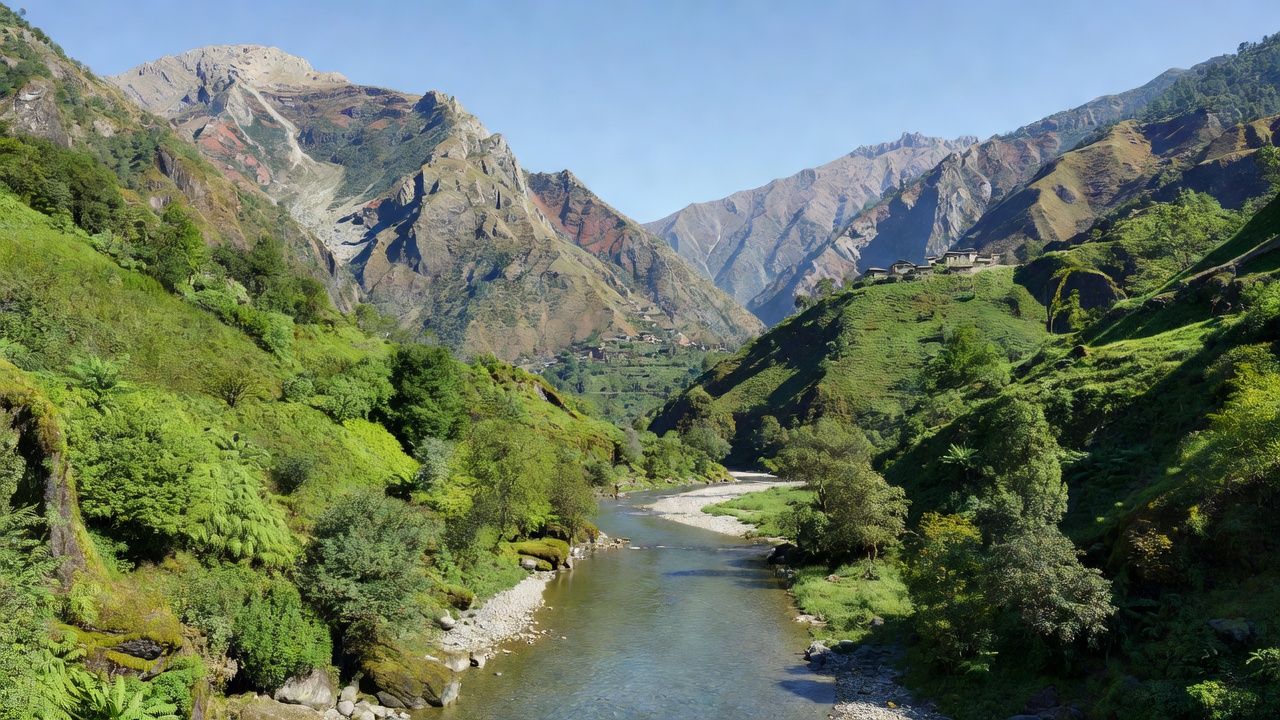
Nepal’s National Disaster Risk Reduction and Management Authority reported that a landslide blocked the Budhi Gandaki River near Chumnubri village before the resulting surge destroyed or damaged about three dozen houses, four bridges and a hydroelectric project construction camp on Sunday. The authority’s chief, Dharam Raj Uprety, said the flood carried away construction equipment and several power and communication towers along the riverside while prompting evacuation orders for communities downstream in districts including Tanahun, Chitwan, East Nawalparasi and West Nawalparasi. Army personnel deployed helicopters and ground teams to rescue 49 people by afternoon, according to an official military statement that confirmed no immediate casualties but noted five individuals missing.
Within a couple of hours the river’s water level at one monitoring point rose from two metres to 8.5 metres, Uprety told reporters, as a video from the scene showed raging waters washing away an entire building complex. Government meteorologist Binod Parajuli stated that the hydrological station was swept away, leaving officials without real-time data from the location. The National Disaster Risk Reduction and Management Authority placed the country on high alert, urging residents along the riverbanks to move to safer ground as communities prepared for the major Dashain festival.
This latest flooding struck as Nepal struggles to recover from catastrophic August floods triggered by a glacier collapse near the Tibet border that killed at least 1,455 people with more than 5,000 still missing, according to updated figures from the National Disaster Risk Reduction and Management Authority reported by Reuters. That disaster affected nearly 33,000 people and damaged or destroyed around 7,500 homes while disrupting key trade routes with China, the UN resident coordinator Lila Pieters Yahia said in a statement following the event. Reconstruction and recovery needs could reach $4.77 billion, equivalent to about 10 percent of Nepal’s gross domestic product, Prime Minister Balendra Shah told the United Nations General Assembly in September.
A preliminary assessment released by the International Labour Organization estimated that more than 21,400 workers living near the August flood zone lost livelihoods in tourism, agriculture, transport and small businesses, with additional impacts rippling through supply chains dependent on the damaged Nepal-China trade corridor that handles 22 percent of imports from its northern neighbour. The World Bank made up to $170 million in emergency financing available to support early recovery efforts, according to a Reuters dispatch citing government coordination with international partners. Nepal’s disaster authority has calculated initial property, housing and infrastructure losses from the August event at 387.5 billion Nepalese rupees, or roughly $2.56 billion.
Scientists from the World Weather Attribution group determined that human-induced climate change played a substantial role in preconditioning the August glacier collapse by raising regional temperatures about 1.5 degrees Celsius above normal levels and contributing to permafrost thaw and altered precipitation patterns across the Himalayas. Nepal, which accounts for less than 0.1 percent of global greenhouse gas emissions, has repeatedly called for climate justice and grant-based international support rather than additional loans for reconstruction, Shah stated during his UN address. The United Nations has launched a flash appeal for $49.6 million to provide shelter, healthcare and cash assistance to 84,000 affected people through the end of the year.
In response to repeated glacial lake outburst risks, the government will begin studies this fiscal year on draining four of the most dangerous lakes as part of a $50 million climate adaptation project, according to officials cited in a Reuters report. Shah has proposed a trilateral Himalayan Climate Resilience Mechanism with India and China to share satellite data, monitor glacial lakes and coordinate cross-border early warnings. The National Disaster Risk Reduction and Management Authority continues to focus resources on both immediate alerts for events such as Sunday’s flood and longer-term efforts to restore damaged hydropower capacity that accounts for nearly all of Nepal’s electricity generation.