ع
ع


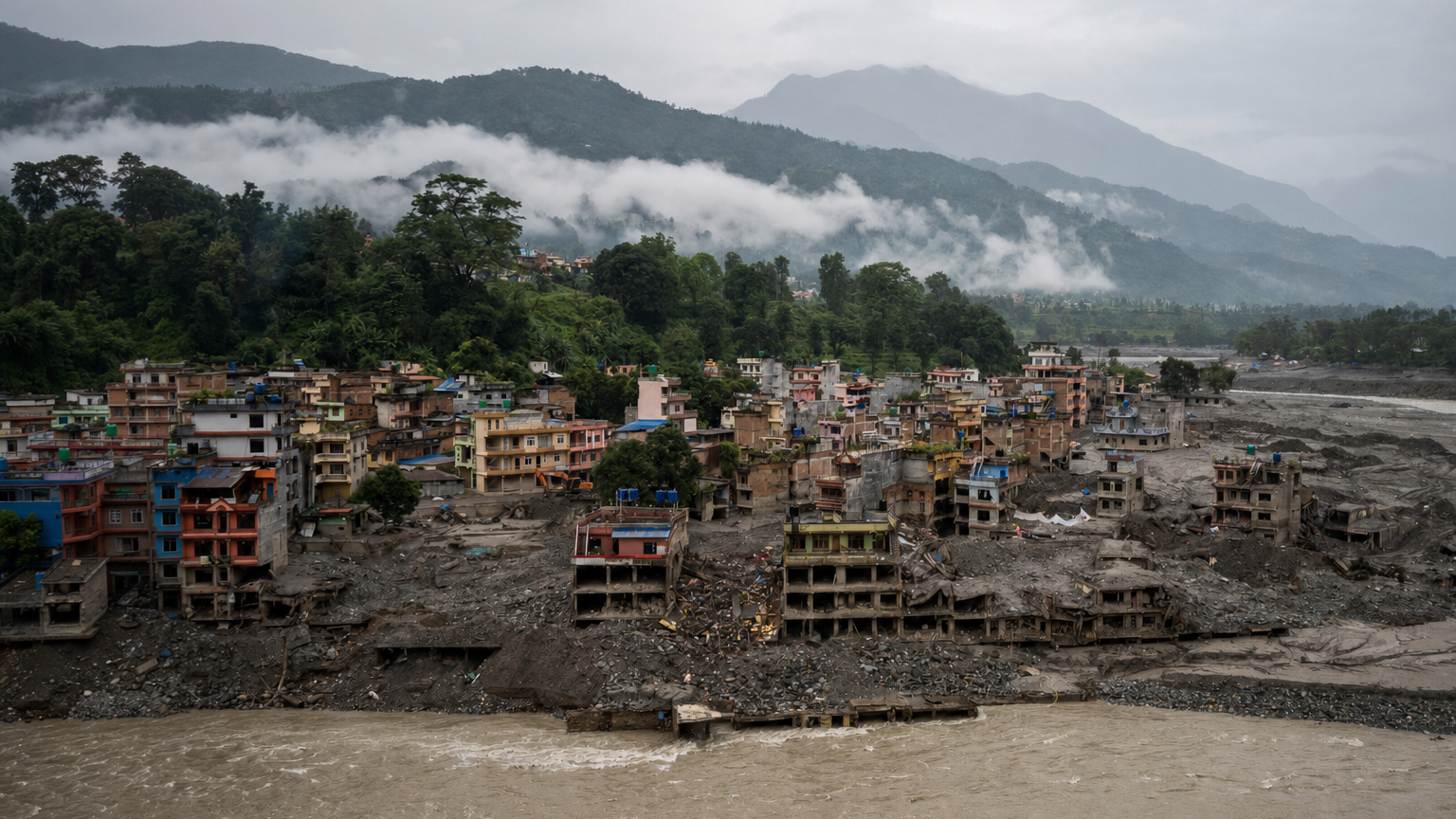
Footage shared by the BBC under the title Watch: Moment a government building collapses into a river in Nepal amid floods showed one of 48 government structures swept away in the surging waters of the Trishuli River system, according to Nepal’s National Disaster Risk Reduction and Management Authority. The collapse formed part of a larger disaster set off when a section of glacier and bedrock broke away from Langtang Lirung peak, sending ice, rock and mud into the Lhende Khola tributary on the Nepal-Tibet border. A preliminary assessment by the United Nations Development Programme placed the resulting debris across affected valleys at 2.2 million tonnes, including building fragments, sediment and vegetation that complicated rescue operations for weeks afterward. The authority’s figures show the floods damaged or destroyed thousands of homes alongside the public buildings in districts including Rasuwa, Nuwakot and Dhading.
National Disaster Risk Reduction and Management Authority data updated in late September placed the confirmed death toll at 1,453 with 5,285 people still listed as missing a full month after the August 26 event. The United Nations Development Programme reported that more than 84,000 people were affected across 17 municipalities while nearly 33,000 lost their shelter when roughly 7,570 houses were impacted. Rescue teams from Nepal, China and India recovered more than 13,000 survivors and retrieved hundreds of bodies, many of which required DNA profiling for identification because of the force of the debris flows, the authority stated. The disaster also claimed 43 lives in Tibet with over 500 missing on the Chinese side according to official tallies cited by Reuters.
A Rapid Damage and Needs Assessment issued by Nepal’s National Planning Commission and the disaster authority estimated reconstruction costs at 723 billion Nepali rupees, equivalent to about 4.7 billion dollars. The floods destroyed or severely damaged at least 12 hydropower projects with a combined capacity exceeding 900 megawatts, several of them still under construction at the time of the deluge, a UNDP review found. Around 70 kilometres of roads and 80 bridges were washed out or blocked by sediment, severing the main trade route with China at the Rasuwagadhi border crossing where the Gyirong Port was obliterated, according to government satellite assessments. The authority noted that seven health facilities and 18 schools also sustained damage in the remote valleys.
Prime Minister Balendra Shah said in a social media post that thousands of citizens had lost homes, families and property while pledging government support for displaced residents, Reuters reported. The premier’s administration, which took office earlier in 2026 after months of political upheaval, faced immediate pressure to coordinate large-scale recovery in a country whose annual budget stands near 14 billion dollars, an Associated Press dispatch noted. International teams assisted with heavy machinery and helicopters to reach isolated hydropower tunnels where nearly 300 workers had been trapped, the National Disaster Risk Reduction and Management Authority detailed in its situation updates.
Experts cited by NPR and The New Humanitarian attributed the scale of destruction to a combination of rapid glacial melt accelerated by global warming and the concentration of hydropower infrastructure in vulnerable Himalayan river corridors. The US Geological Survey determined that the initial seismic signal registered as a magnitude 4.4 event was produced by the glacial collapse and debris flow rather than an earthquake, according to statements relayed by The Guardian. A geographer at Appalachian State University told media outlets that many engineers and labourers at the affected projects likely perished, underscoring long-standing concerns about building standards in seismically and hydrologically active terrain.
The United Nations Population Fund reported that 352,000 people were affected overall, including nearly 100,000 women of reproductive age, with 3,600 remaining in crowded displacement sites where risks of gender-based violence and disease outbreaks had risen. UNFPA dispatched dignity kits, tarpaulins and mobile health teams while appealing for 3.5 million dollars to sustain response activities through early 2027. The National Disaster Risk Reduction and Management Authority indicated that warnings sent via text message to nearly one million residents ahead of subsequent heavy rains in late September helped limit additional casualties from follow-on landslides and flooding.