ع
ع


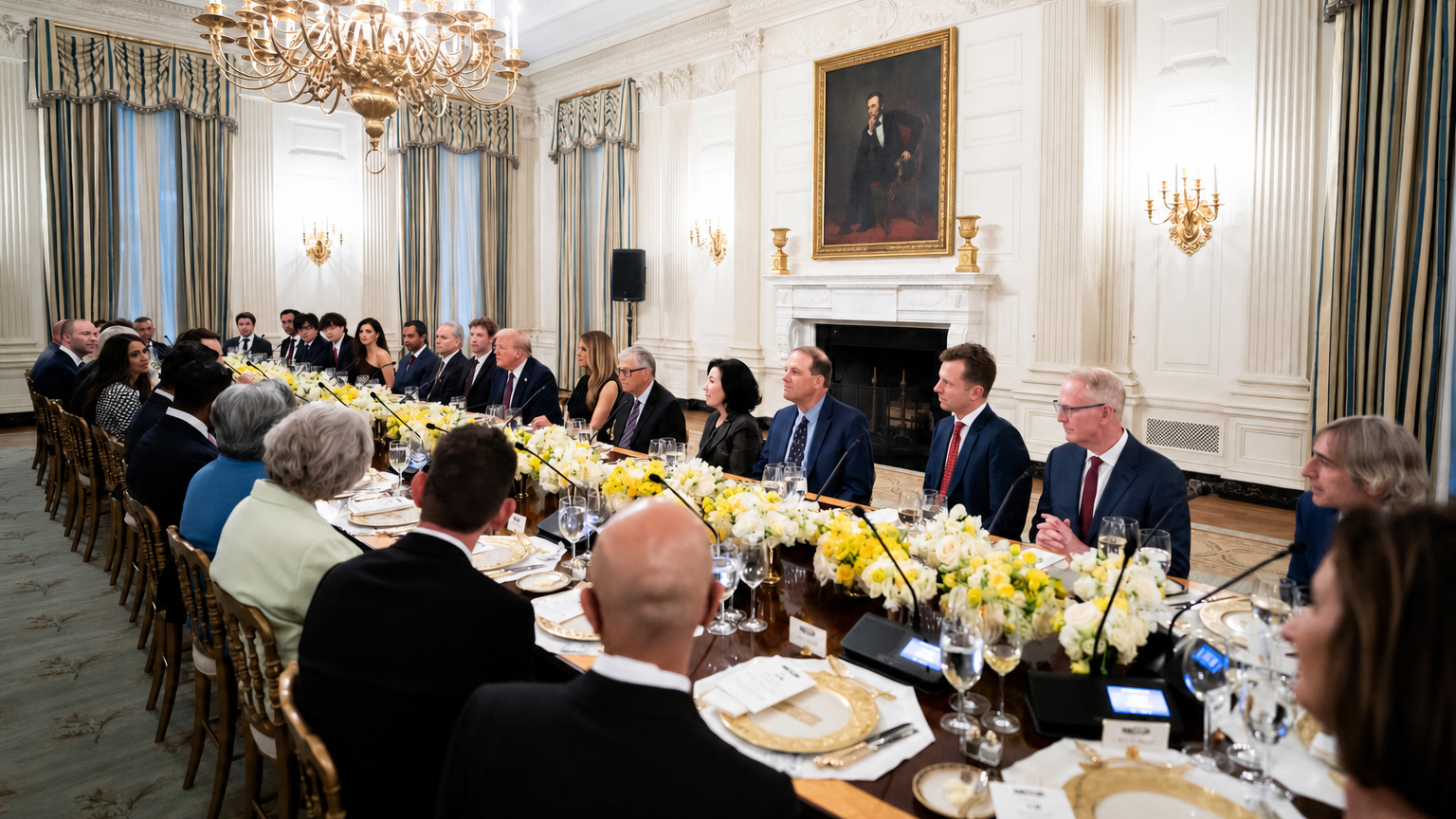
President Donald Trump convened an unprecedented gathering of technology leaders at the White House on September 29, 2026, that included Elon Musk of xAI, Mark Zuckerberg of Meta, Sundar Pichai of Google, Jensen Huang of Nvidia, Dario Amodei of Anthropic and Greg Brockman of OpenAI. House Speaker Mike Johnson attended the closed-door session and later told reporters that the assembly marked the first time such a group had convened in one room, crediting Trump with making the meeting possible. The discussions centered on balancing rapid innovation with safety considerations while maintaining a competitive advantage over nations such as China, according to a statement Johnson released afterward.
A BBC News report outlined three takeaways from the summit, starting with an agreement that commits the participating companies to self-regulation rather than new federal mandates. The White House Accord on Super Intelligence, which Trump described as morally binding, requires four layers of controls that encompass robust internal monitoring for risks including cybersecurity, biosecurity and chemical threats, according to the text released by the administration. Companies further agreed to maintain internal teams for oversight, engage independent external auditors and establish board-level committees to review findings, with regular meetings planned to develop shared best practices.
Trump told reporters after the session that the executives would engage in tremendous self-policing, adding that the document represented a form of protection for the public. The New York Times reported that the one-page accord echoes voluntary commitments made during the prior administration but stops short of enforceable government rules, leaving enforcement to the companies themselves. Speaker Johnson noted in his remarks that innovation in safety would advance alongside technological progress as the firms committed to accountability.
The second takeaway focused on substantial infrastructure investments that Trump said are reindustrializing the United States and generating jobs across multiple sectors. A White House fact sheet placed the funding for the Genesis Mission, aimed at accelerating breakthroughs in science, medicine, energy and manufacturing through the technology, at more than $5 billion. These data centers and computing facilities form part of a broader push that the administration has framed as essential to sustaining global leadership in the field.
Trump signed an executive order on the same day that directs all federal departments and agencies to replace the terms artificial intelligence and AI with super intelligence and SI in official documents, websites and communications, according to the White House release. The order states that advancing capabilities have moved beyond artificial intelligence into a new era that the updated terminology better reflects. The fact sheet further indicated that the administration had already eliminated certain prior policies it viewed as restrictive before announcing a national framework with legislative recommendations in March 2026.
Trump indicated he would name an AI czar within the next three or four days, a development reported across outlets including CBS News and The Pavlovic Today. He also referenced recent conversations with Chinese President Xi Jinping in which the importance of the assembled executives was acknowledged. Additional attendees at the luncheon included Jeff Bezos of Amazon and Alex Karp of Palantir, according to participant lists cited by multiple news organizations.
The accord leaves open the possibility of later codifying the voluntary steps into law or regulations, as stated in the document itself. Johnson emphasized that the balance struck during the meeting would benefit the American people while preserving the nation’s edge in the technology. The White House has described the overall approach as one that unleashes innovation following the removal of earlier regulatory measures.