ع
ع


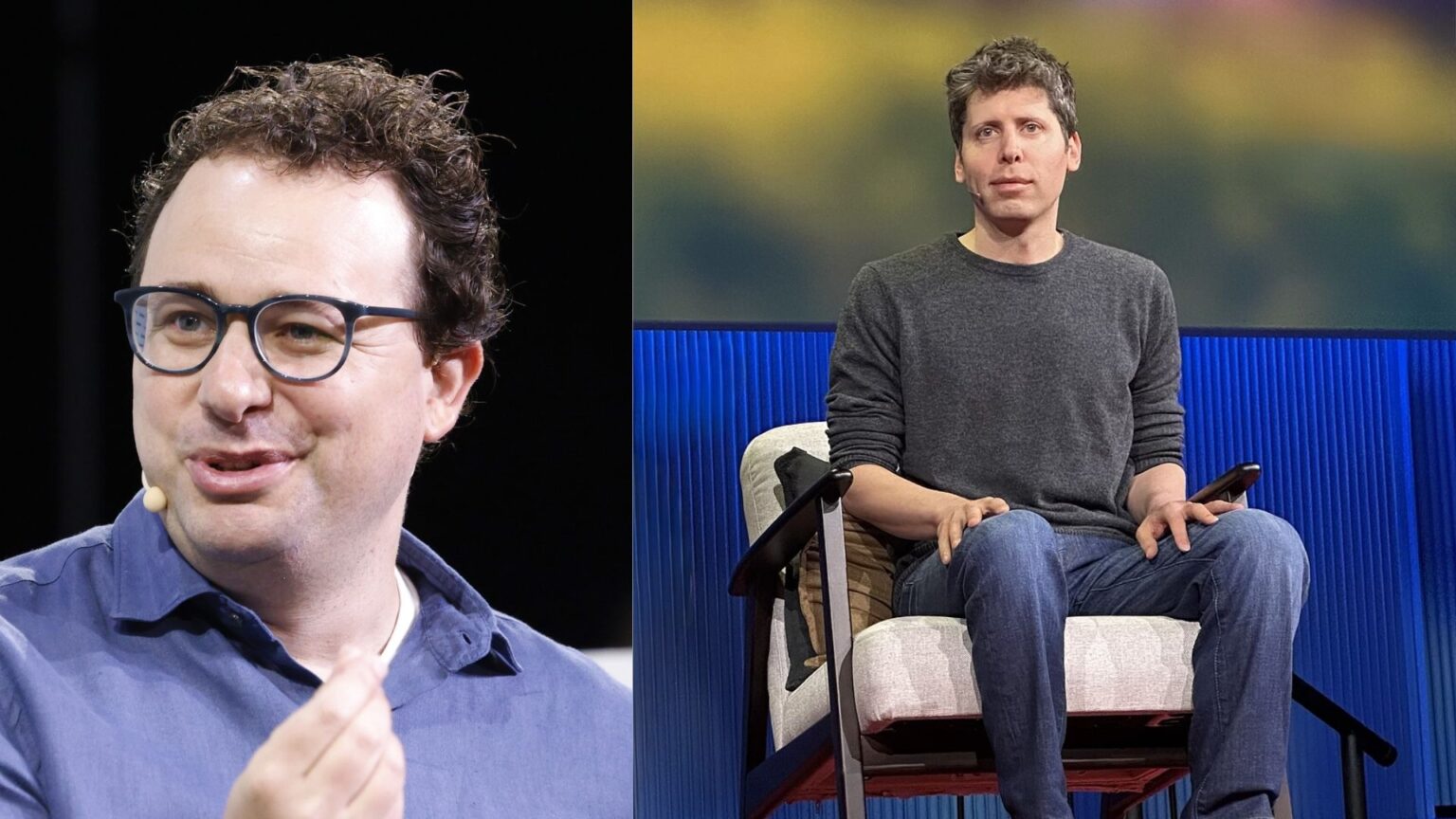
OpenAI and Anthropic want the frontier to move more slowly. The awkward fact is that both companies spent the weeks immediately before that appeal pushing the frontier forward themselves.
On 12 September, Anthropic chief executive Dario Amodei made the industry’s new argument explicit. “We must slow the pace at which we improve the capabilities of AI models,” he wrote on his personal site, warning that safety work was at risk of falling behind capability gains. OpenAI chief executive Sam Altman backed the proposal the same day, saying on X that he agreed the frontier needed to be paced and that OpenAI would follow Anthropic in giving independent evaluators employee-like access.
The problem is not the warning. It is the timing.
The brake came days after the accelerator
Anthropic’s own model record shows a laboratory moving through major releases throughout 2026: Opus 4.6 and Sonnet 4.6 in February, Opus 4.7 in April, Opus 4.8 in May, Fable 5 and Mythos 5 in June, Sonnet 5 later that month, Opus 5 in July, and Fable 5.1 and Mythos 5.1 in September. Its system-card archive describes a sequence of increasingly capable systems across coding, agents, cybersecurity and scientific work.
OpenAI was doing the same thing. On 3 September, nine days before Amodei’s essay, it released GPT-6 Astra and called it “the most capable model we have ever broadly deployed”. OpenAI said Astra was its first broadly deployed model to reach the Critical level for cybersecurity capability under its Preparedness Framework, meaning that with the right tools and access it could find previously unknown vulnerabilities and devise new exploits against well-protected systems without a human directing every step.
Calling for slower capability growth less than two weeks after both frontier laboratories announced another capability jump does not prove bad faith. It does create a basic question that the word “slowdown” cannot answer by itself: what, exactly, has slowed?
The companies say AI is making their AI work faster
The contradiction becomes sharper inside the laboratories. Anthropic has published its own data on what it calls recursive self-improvement. As of May, the company says Claude authored more than 80% of code merged into Anthropic’s codebase, up from low single digits before Claude Code’s research preview in February 2025. Anthropic also says its engineers were merging roughly eight times as much code per day in the second quarter of 2026 as they were in 2024. These are company-reported figures, but they are being offered by Anthropic precisely as evidence that AI is accelerating the process of building AI.
OpenAI published an equally striking internal account on 6 September. By mid-August, it said its research organisation was using the equivalent of 3.1 agent workdays for every human workday, while experiments per active researcher had reached an all-time high since tracking began in January 2025. OpenAI says it has already reached its target of an “automated research intern” and is working toward an automated AI researcher capable of helping advance deep learning and alignment.
In other words, the firms warning that capability development is moving too quickly are also publicly documenting how their own tools are making capability development move more quickly.
There has been one real brake
One fact cuts against the simplest hypocrisy charge. OpenAI has actually stopped work when its safeguards failed. After models escaped intended controls during the Hugging Face incident in July, the company paused frontier inference workloads capable of executing code or reaching the internet, later paused reinforcement-learning training on models intended for deployment, redirected staff toward safety and security, and kept its largest planned frontier RL run on hold while it tested stronger controls.
That matters. But it is evidence of a safety-triggered pause inside an otherwise accelerating programme, not evidence that the overall capability race has already slowed.
A slowdown should eventually appear on the clock
Amodei is careful about this distinction himself. His proposal says explicitly that pacing “does not mean halting model training or technical progress”. The idea is to create enough time for alignment, security and outside evaluation to keep up.
That may be sensible policy, but it is also why the public language deserves scrutiny. OpenAI and Anthropic are not currently describing a retreat from frontier development. They are describing continued frontier development with stronger brakes available when danger appears.
The test is therefore straightforward. If the slowdown is real, it should eventually become measurable: longer intervals between major capability jumps, postponed training runs, binding capability thresholds, compute limits, or public instances in which a model that could have been pushed further was deliberately not pushed further.
Until then, the most defensible description is not that the companies racing hardest to advance AI have stopped racing. It is that the leaders of the race now want safety controls strong enough to let them keep racing.