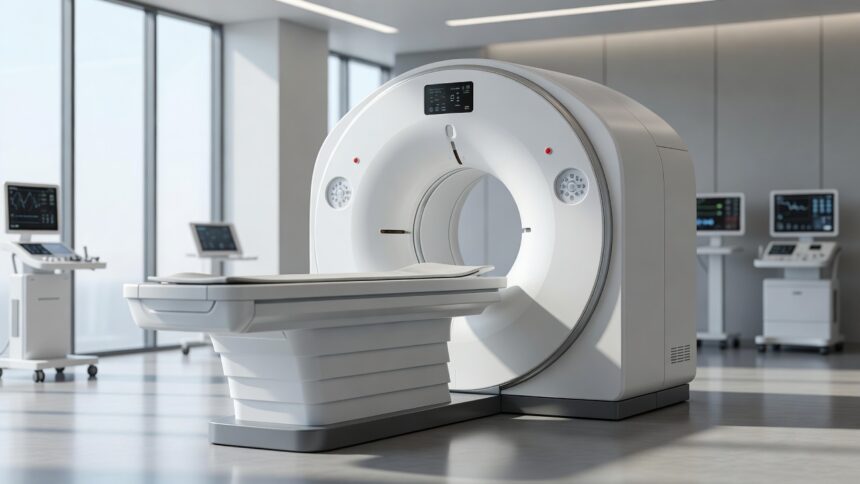
Midjourney announced on June 18, 2026, that it has formed Midjourney Medical, a new division dedicated to healthcare imaging with a full-body ultrasound scanner that completes scans in 60 seconds, the company said in a post on X. CEO David Holz described the device as superior to MRI machines in numerous respects while relying solely on sound waves and water with no radiation or magnetic fields. The company aims to install around 50,000 such scanners worldwide within six years to facilitate 1 billion full-body scans monthly.
Midjourney’s announcement on X detailed the scanner as an Ultrasonic CT system capable of whole-body imaging that the firm believes will advance healthcare diagnostics. Bloomberg reported that Holz stated no such device had been built until now during an event in San Francisco. The technology forms the centerpiece of the division’s initial hardware project, according to the company post.
The first Midjourney Medical facility, dubbed the Midjourney Spa, is scheduled to open in San Francisco by the end of 2027 and will feature 10 scanners alongside hot tubs, saunas and cold plunges. That single location is projected to perform more scans annually than all MRI machines currently operating on Earth combined, the company said. Midjourney framed the spa as a wellness-oriented site to introduce the new imaging approach.
Midjourney’s deployment targets call for the global network of 50,000 scanners to generate 1 billion full-body scans per month once fully operational in six years. The company positioned the initiative as a response to limitations in existing imaging methods that often involve longer durations or potential health risks from radiation or strong magnetic fields. Officials have not released technical specifications or regulatory approval timelines in the initial announcement.
A Grand View Research assessment found the artificial intelligence medical imaging market stood at USD 1.8 billion in 2025 and is projected to reach USD 20.2 billion by 2033 while expanding at a compound annual growth rate of 35.11 percent from 2026 onward. The figures underscore rising demand for enhanced diagnostic tools that process growing volumes of imaging data with greater speed and accuracy. Midjourney’s hardware entry aligns with broader sector shifts toward integrated AI and advanced scanning systems.
Midjourney, a community-funded research laboratory of about 60 people, built its reputation on generative AI models for creating images from text prompts before venturing into medical applications. The company maintains that all individuals exist in a midjourney between a rich past and an unimaginable future, a philosophy now extending to its medical imaging efforts. Its website highlighted the new division shortly after the X post went live.
Bloomberg noted that the San Francisco event marked Midjourney’s first foray into hardware development, surprising observers familiar with its software background in AI art generation. Holz characterized the project as filled with hope despite its unconventional nature. The division’s progress will depend on further details about integration with diagnostic AI and compliance with global medical device standards.