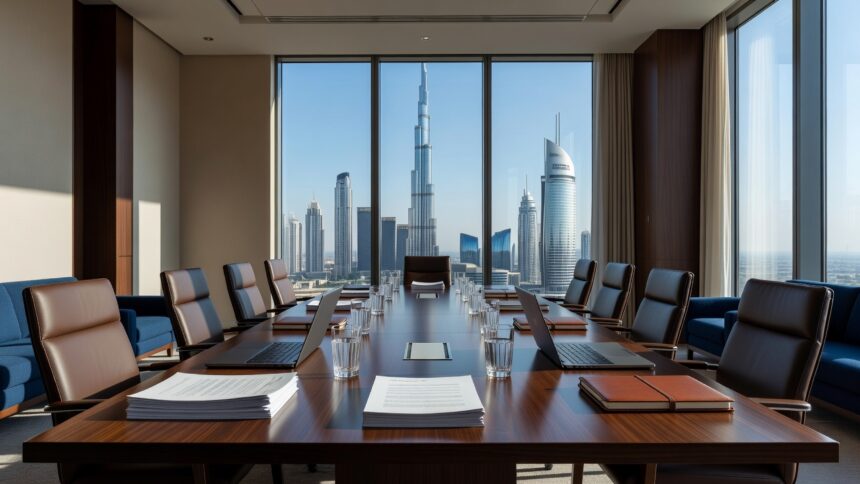
The World Governments Summit and Fiker Institute launched the Foreign Policy Toolkit for 2026 on February 1 in Dubai. The resource draws on the institute’s analysis and expert insights to forecast major global geopolitical trends while outlining their implications for governments and the private sector. Fiker Institute has served as a knowledge partner to the summit since 2022, according to a statement from the organizations.
The toolkit examines security, political and environmental issues with broader geopolitical and geoeconomic impacts across the Middle East and North Africa, Asia-Pacific, Africa, the Americas and Europe. It maps a less predictable and more transactional multilateral scene that will carry major implications for the global economy along with rising conflicts shaping international security and diplomacy. Authored by Miriam Aitken and Shurouq Jaradat, the document is designed to help decision-makers anticipate risks and formulate responses, the launching organizations said.
The World Governments Summit began in 2013 and has since hosted more than 100 heads of state and government while establishing itself as a premier platform for discussions on governance and innovation. Past editions have drawn thousands of ministers, experts and business leaders to address emerging global challenges, WAM has reported. The 2026 gathering in Dubai featured the toolkit as part of its focus on strategic foresight amid international volatility.
Fiker Institute was established in Dubai in September 2021 as an interdisciplinary think tank that seeks to advance dialogue on global politics with a focus on reshaping narratives around the Middle East. The institute maintains a specialized library of more than 15,000 books on world history, politics and culture while running regional programs that analyze power shifts involving Gulf states and Europe’s position in the global order. Its website details how these initiatives address multipolarity and domestic developments affecting foreign policy.
Comparable outlooks have echoed the toolkit’s emphasis on fragmentation and uncertainty. A Council on Foreign Relations assessment published in December 2025 identified competition for critical minerals, tariff effects, nuclear agreements and humanitarian aid cuts among the defining trends for 2026. The Center for Security Studies at ETH Zurich released its Strategic Trends 2026 in April, describing a mosaic international order marked by uneven fragmentation, accelerating change and greater agency for small and middle powers.
The Uppsala Conflict Data Program has recorded more state-based armed conflicts in recent years than at any point since 1946, aligning with the toolkit’s warnings on security pressures testing global governance. Such conditions have elevated the importance of analytical resources for both public institutions and private enterprises navigating supply chains and diplomatic relations. The report remains available on the World Governments Summit observer platform for further reference.