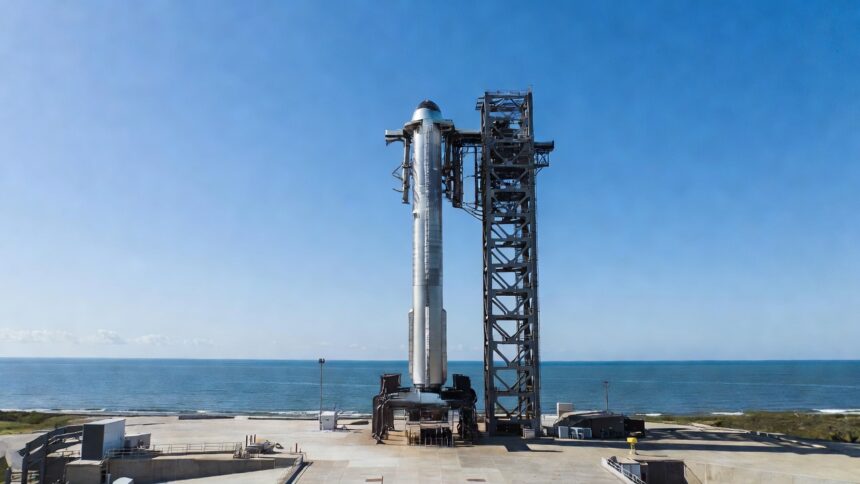
A Blue Origin New Glenn heavy-lift rocket exploded during a hot ignition ground test at Cape Canaveral Space Force Station in Florida on May 29, 2026, producing a large fireball, the Qatar News Agency reported. Blue Origin described the event as an anomaly in a post on X, confirming that all personnel were accounted for with no injuries. The test formed part of preparations for the vehicle’s fourth launch, planned to deploy Amazon Leo internet satellites following the third mission on April 19 that carried the Blue Bird 7 satellite from the same site.
The Qatar News Agency reported that the explosion occurred while the rocket’s engines were ignited on the ground ahead of the upcoming flight. According to multiple accounts, the blast destroyed the launch vehicle and inflicted severe damage on Launch Complex 36, Blue Origin’s sole operational site for New Glenn, toppling a 600-foot lightning tower. No payload satellites were mounted on the rocket during the test.
Blue Origin CEO Dave Limp stated that the company plans to fly New Glenn again before the end of 2026. He noted that assessments showed more of the launch pad infrastructure remained in good condition than anticipated after the incident. A Space.com report indicated that the explosion was among the largest in the company’s history and has suspended operations at the site pending full investigation and repairs.
The setback affects NASA’s Artemis program, in which Blue Origin is contracted to deliver lunar landers and support cargo missions using New Glenn. A New York Times assessment found that the incident could delay elements of the effort to return humans to the moon by 2028. Blue Origin has been positioned as a key partner alongside SpaceX for achieving sustainable lunar presence under the program.
Amazon signed a multibillion-dollar contract with Blue Origin in 2022 for at least 12 New Glenn launches, with options for more, to deploy its Leo low-Earth orbit constellation aimed at providing global broadband. The delay to the next mission will push back the rollout of these satellites, a CSIS analysis noted in the context of broader commercial launch demand. Industry projections indicate that scaling New Glenn operations is essential to meet both commercial broadband targets and government mission requirements.
Development of New Glenn began before 2013 and the vehicle was formally announced in 2016, according to Blue Origin documentation. The rocket, named after astronaut John Glenn, employs seven BE-4 engines on its reusable first stage and is engineered for heavy payloads to low-Earth orbit and beyond. Blue Origin, established by Jeff Bezos in 2000, has achieved booster recoveries on prior New Glenn flights, establishing its role in advancing reusable orbital launch capabilities.
Further details on the anomaly investigation and a revised launch schedule are expected as Blue Origin completes its review of the damaged facilities. The company has emphasized safety protocols in its public statements following the event. Updates will continue to be issued through official channels as repair work progresses at the Cape Canaveral site.