ع



Ahead of Satori in Casablanca, the Moroccan artist explains how working with clay extends the questions about light and perception that have occupied him since the pandemic.
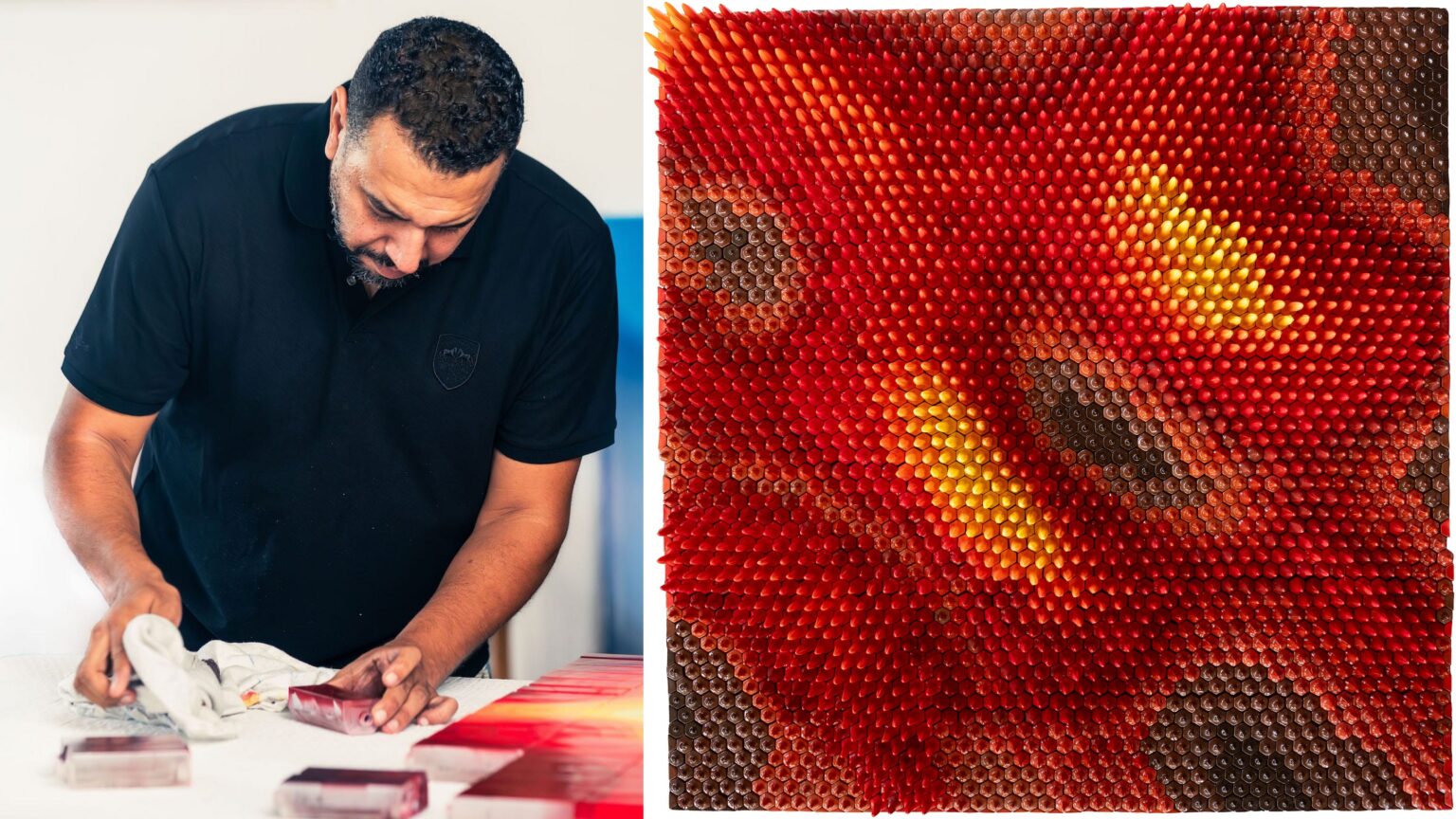
In Braises de lumière, small red and amber projections rise from a field of hexagonal forms. Yellow curves through the composition, while dark brown areas interrupt its brightness. Light catches the raised surfaces and shadows gather between them. At 2.2 metres high and wide, the ceramic work brings small differences in colour and height into a composition that can be read from across a room.
For Younes Khourassani, clay offered the chance to explore those differences with his hands. “After years of working with colour and gradients, I felt a need to touch material again, to experience its density and resistance, and the trace left by the hand,” he says. The colour knowledge developed through painting now informs a surface he can press, bend and build outwards.
Born and trained in Casablanca, Khourassani graduated from the city’s École des Beaux-Arts in 2001. His practice spans assemblage, painting and sculpture, with matter remaining central throughout. Braises de lumière offers a preview of the ceramic research he will present in his forthcoming exhibition, Satori, at La Galerie 38 in Casablanca.
What the hand discovers
A drawing gives Khourassani his starting point, setting out proportions and the position of each form. Shaping the clay can change that plan. A pressure or movement leaves a mark, and the material’s response may suggest an adjustment he had not anticipated on paper. As he puts it, “The hand participates directly in the thinking.”
The raised units in Braises de lumière show how closely shape and colour work together. Their repetition gives the eye a pattern to follow, while differences in height and hue interrupt it. Yellow passages connect separate areas; projecting red forms catch light and cast shadows around their neighbours. The edges and spacing of the pieces help determine how the work is seen.
Khourassani also considers where the relief meets the wall. He judges how far a form reaches towards the viewer and where a recess holds shadow. Light helps organise the work through decisions about depth, finish and spacing. A mark made during shaping remains in the clay, although a change in lighting can make it more visible or harder to distinguish.
A different pace after the pandemic
His attention to these changes grew during the pandemic, when he experienced “a slower, quieter sense of time” and felt “an inner need for light and a greater space for contemplation”. He began pursuing depth and a sense of passage through colour gradients and geometric forms, searching for light that seemed to take shape within colour.
In his paintings on aluminium, he develops that movement through thin layers. He adjusts the density of a shade, the width of a transition and the direction of a form, considering where the eye will go first and where it might pause. One area can appear to come forward while another seems to recede, even though both occupy the same smooth surface.
The actual light in the room adds further changes. A transition between shades may become visible from one angle after appearing uniform from another. Moving closer brings small distinctions into view. The work holds its physical form, while the viewer gradually discovers more of it.
Clay extends this enquiry through actual depth. It can hold the trace of a hand and produce a shadow that shifts with the light. Khourassani describes the thread running through his practice as a desire to explore “how matter can acquire a presence that carries feeling and thought”. His interest in light grows through his work with the material and what it can reveal.
Colour tested by fire
Getting those surfaces right takes repeated experiments. Firing causes a permanent chemical change, turning clay that could once be reclaimed and reworked into ceramic. Once a piece enters the kiln, Khourassani can no longer intervene directly in its transformation. He has to wait, then look carefully at what has happened before deciding whether to try again or develop an unexpected detail.
Colour adds another set of variables. He has mixed his own paints and built a personal library of dozens of shades. Glaze requires him to test ingredient proportions, water, application and firing temperature, any of which can affect the finished colour, texture or sheen. A shade that works on its own must then be considered beside the other pieces.
The final assembly brings those experiments into one composition. Khourassani adjusts balance, rhythm and spacing, assessing how differently shaped and coloured parts work together. This repeated cycle of making, testing and reconsidering gives substance to the three years of research behind the exhibition. The finished surface holds decisions made at each stage, including those prompted by the material itself.
What a second look can reveal
The title Satori refers to a Zen Buddhist experience of enlightenment. Khourassani has used it before: an installation of that name was presented at 1-54 Marrakech in 2025. In describing that earlier work, La Galerie 38 connected the term with a fleeting moment of understanding, such as the recognition sparked by two colours meeting.
That earlier use offers context for the title’s return. In his current account of working with clay, Khourassani locates the spiritual dimension in the closeness of touching, shaping and waiting. He is interested in how a material with weight and density can carry a feeling of lightness, explored through proportion, colour and the way its surface receives light.
Satori will run at La Galerie 38 in Casablanca from 26 November 2026 to 9 January 2027. For visitors, the ceramic surfaces will offer different things at different distances: an overall rhythm from farther away, details of shaping and finish up close. A step to the side can change a reflection or bring a shadow into view.
Khourassani leaves that pace to the person looking. “I hope viewers give themselves the chance to notice what does not appear at first glance, and to discover the distance and way of looking that suit them.”