ع
ع


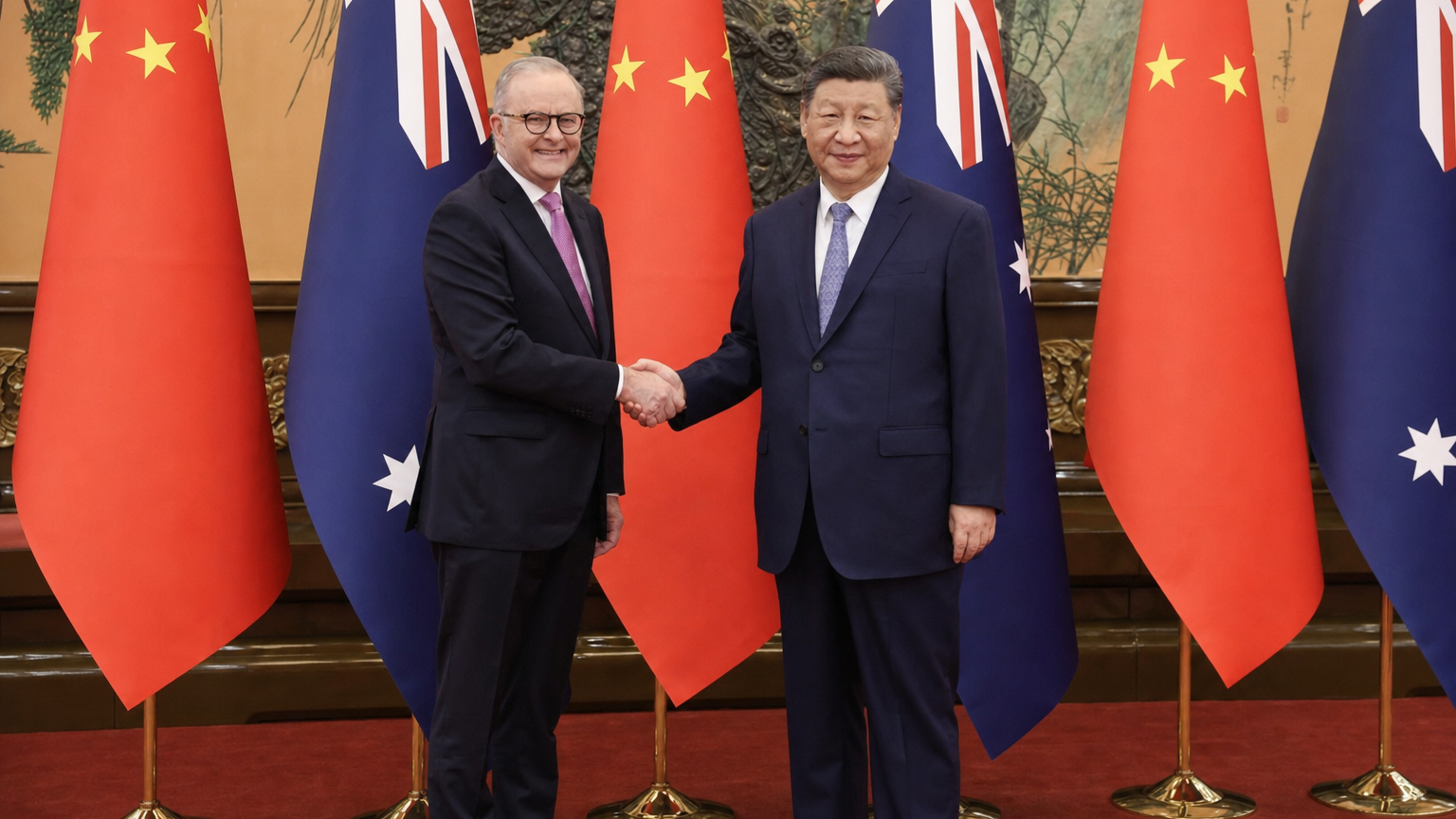
The Lowy Institute reported that Australia sends around 35 percent of its exports to China with the trading relationship valued at A$326 billion in 2025 even after Beijing lifted its final trade blockages in December 2024. According to the institute’s latest poll only 20 percent of Australians express trust in China a figure that has improved modestly from recent lows. A Foreign Policy assessment noted that this economic reliance continues to shape Canberra’s approach to security issues as the Albanese government which was re-elected in 2025 has pursued both stabilization with Beijing and closer alignment with Washington.
A UK-US-Australia analysis from the Center for Strategic and International Studies found that the AUKUS naval nuclear propulsion agreement entered into force in January 2025 followed six months later by the Geelong Treaty covering submarine design and construction. China has opposed the pact at every opportunity with its ambassador to the IAEA describing AUKUS in November 2025 as a textbook case of nuclear proliferation. The Australian government has contributed more than $2 billion toward expanding US submarine production capacity and reaffirmed during recent AUSMIN talks that the initiative remains full steam ahead despite a Pentagon review earlier in the year.
Prime Minister Anthony Albanese visited China in July 2025 meeting President Xi Jinping and touring cities including Chengdu in an effort to broaden economic engagement beyond coastal hubs. Albanese warned that broad US tariffs imposed in 2025 represented an act of economic self-harm while refusing invitations to jointly oppose them with Beijing. The Trump administration applied a baseline 10 percent tariff on Australian imports under trade legislation yet exempted key sectors and maintained Australia as a close partner in critical supply chains.
Australia has signed defense cooperation agreements with Papua New Guinea Fiji and Vanuatu in the past two years according to an Australian National University assessment increasing development assistance to the Pacific to A$2.2 billion annually. These pacts include mutual security commitments and policing arrangements designed to counter expanding Chinese influence in the region. The National Security College noted that three-quarters of Australian aid now flows to Indo-Pacific partners reflecting a strategy of bolstering resilience against potential coercion.
A framework signed with the United States in October 2025 aims to mobilize up to $8.5 billion in critical minerals and rare earths projects positioning Australia as a trusted alternative to Chinese processing dominance. The Australian Institute of International Affairs highlighted that China controls the majority of global refined lithium cobalt and rare earth elements making supply chain security a core element of the AUKUS technology pillar. Officials have described the minerals partnership as essential for supporting both defense innovation and broader economic diversification efforts.
Public sentiment data from the Lowy Institute shows Australians’ trust in the United States remains higher than that for China though the gap narrowed to just three percentage points in the latest survey. Joint US-Australia statements from the 2025 ministerial consultations emphasized shared challenges to the international order and expanded force posture cooperation including longer visits by American submarines. The BBC described the overall dynamic as Stuck between superpowers: How Australia navigates the China-US rivalry capturing the persistent tension between economic interests and strategic imperatives.